The FIFA World Cup is usually presented as a celebration of football, national identity and sporting excellence. For billions of supporters, it represents unforgettable goals, dramatic eliminations and the rare opportunity to watch the world’s best national teams compete on one stage.
Behind the excitement, however, the World Cup is also an enormous commercial machine.
Broadcasters sell advertising space, sponsors compete for global visibility, hotels and airlines benefit from travelling supporters, and sportswear companies launch major international campaigns.
One of the industries that benefits most from the tournament is the global sports betting sector.
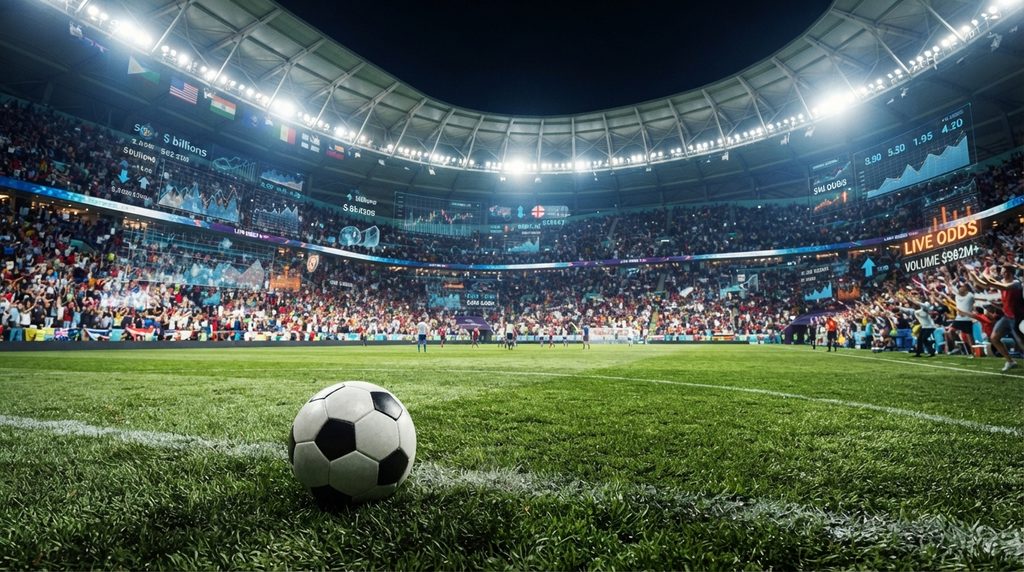
During a World Cup, millions of people place bets on match winners, goalscorers, cards, corners, penalties and even events that occur during a few seconds of play. This creates an extraordinary volume of transactions for bookmakers, betting applications and prediction platforms.
The 2026 tournament, expanded to 48 teams and 104 matches, was expected to become the biggest football betting event ever. Estimates published before and during the competition suggested that global wagers could exceed $50 billion, compared with an estimated $35 billion during Qatar 2022. Some major operators prepared to process as many as 100,000 bets per minute during peak periods.
This spectacular growth has created a major debate:

Are betting companies simply businesses benefiting from football’s popularity, or has gambling become too closely connected to the sport?
Why the FIFA World Cup Is So Profitable for Betting Companies
The World Cup creates conditions that are almost perfect for online bookmakers.
Unlike a domestic league, the tournament attracts both regular gamblers and casual supporters who may only place bets during major international competitions.
A person who never bets during the year may still decide to wager on:
- Their national team winning a match
- A favourite player scoring
- The total number of goals
- A penalty being awarded
- The tournament winner
- The result at half-time
- The number of corners or cards
- A live event during the game
Because the competition contains more than one hundred matches, betting operators can offer thousands of different markets throughout the tournament.
The 2026 format increased the opportunity even further. More teams meant more matches, more countries emotionally involved and more potential customers.
The tournament’s schedule was also commercially attractive. Matches were played across the United States, Canada and Mexico, giving operators access to large audiences across North America, Europe, Africa, Latin America and Asia.
According to Reuters, betting companies reported exceptional levels of customer activity, while some matches became the most heavily wagered football events ever recorded on certain platforms.
Betting Volume Is Not the Same as Profit
Articles about sports betting frequently confuse three different terms:
Betting handle
The total amount of money placed in wagers.
Gross gaming revenue
The amount retained by the operator after paying winning bets, before deducting some operating expenses and taxes.
Net profit
What remains after marketing, salaries, technology, regulatory costs, taxes, customer bonuses and other expenses.
For example, if customers collectively place $1 billion in bets, the bookmaker does not necessarily earn $1 billion.
A large part of that money is returned to winning customers.
The bookmaker’s business model relies on the margin built into the odds, often called the house edge, combined with a very high volume of transactions.
Therefore, headlines claiming that bookmakers “made $50 billion from the World Cup” may be misleading. The figure generally refers to money wagered rather than company profit.
Even so, the tournament can still be highly valuable because it generates:
- Immediate betting revenue
- Millions of new account registrations
- Increased deposits
- Greater brand visibility
- More mobile application downloads
- Customer data
- Opportunities to retain users after the tournament
The biggest long-term prize may not be what a customer bets during one match. It may be the value of keeping that customer active for several years.
How Bookmakers Make Money from Football Bets
Sports betting companies use mathematical models to calculate odds.
The odds are not simply a neutral prediction of what may happen. They normally contain a margin that gives the bookmaker a statistical advantage.
Suppose two teams appear to have an equal chance of winning.
In a perfectly fair market, the odds might reflect a 50% probability for each side. A bookmaker will usually offer slightly lower returns, ensuring that the combined implied probabilities exceed 100%.
This difference creates the operator’s margin.
Bookmakers also continuously adjust odds according to:
- The amount wagered on each outcome
- Player injuries
- Team news
- Market movements
- Weather
- Public betting behaviour
- Professional bettor activity
- Risk-management models
Modern platforms can update live odds within seconds.
This allows users to bet during a match on the next goal, the next card, the next corner or the final result.
In-play betting increases engagement because supporters are encouraged to make repeated decisions throughout the same match rather than placing only one wager before kickoff.
The Battle to Acquire New Customers
The World Cup is not only a competition between national teams. It is also a major marketing battle between betting companies.
Operators compete through:
- Free bets
- Deposit bonuses
- Enhanced odds
- Cashback offers
- Referral programmes
- Influencer partnerships
- Television advertising
- Social-media campaigns
- Push notifications
- Live statistics
- Personalised promotions
These offers can attract customers quickly, but they are expensive.
A company may spend heavily during the World Cup even when its immediate profit margin is limited. The strategy is to acquire new users and recover the cost through future activity.
This explains why major tournaments are treated as customer-acquisition opportunities rather than isolated one-month events.
The challenge for operators is retention.
Someone may open an account to bet on Morocco, France, Argentina or England, but the company wants that person to continue betting on club football, basketball, tennis or other sports after the World Cup ends.
Prediction Markets Add a New Dimension
Traditional bookmakers were not the only companies benefiting from the tournament.
Prediction-market platforms also experienced rapid growth.
Reuters reported that Kalshi recorded approximately $27 billion in trading volume during the 2026 World Cup and attracted around three million users, substantially exceeding its own forecasts. The company allows users to trade contracts based on the outcome of real-world events, including sports.
Prediction platforms argue that they operate differently from traditional gambling companies because users trade event contracts in a market.
Critics, however, say the consumer experience can be extremely similar to betting and may create many of the same concerns, including:
- Gambling addiction
- Insider information
- Market manipulation
- Regulatory uncertainty
- Access by vulnerable users
Several American states have challenged prediction markets legally, arguing that certain sports contracts may violate state gambling rules.
The rapid success of these platforms shows that the relationship between football and financial speculation is evolving.
FIFA and Betting-Industry Sponsorship
The debate becomes more complicated when betting companies move from external advertisers to official football partners.
In May 2026, FIFA announced Betano as an official regional tournament supporter for Europe and South America. The agreement gave the betting brand an official commercial relationship with the FIFA World Cup.
Official FIFA partners can receive major commercial benefits, including brand exposure, promotional opportunities, hospitality access and association with one of the world’s most recognisable sporting events.
For betting companies, this creates legitimacy and visibility.
For FIFA, sponsorship generates commercial revenue.
Critics argue that such partnerships create a contradiction.
Football authorities say they are committed to protecting competition integrity and preventing match manipulation. At the same time, they may accept sponsorship from companies that financially benefit from large volumes of football betting.
Supporters of the partnerships respond that licensed bookmakers:
- Operate legally in regulated markets
- Share suspicious-betting information
- Support monitoring systems
- Pay taxes and licensing fees
- Can help identify unusual market activity
The central issue is not necessarily whether all betting sponsorship is unacceptable. The debate concerns how much influence the industry should have and what safeguards should be required.
Why Gambling Advertising Around the World Cup Is Controversial
The World Cup attracts families, teenagers and children, not only adult gamblers.
For critics, this makes gambling advertising particularly sensitive.
Research published by the University of Sheffield ahead of the 2026 World Cup raised concerns about the volume and timing of gambling advertising. It noted that gambling-related harm can carry substantial health, social and economic costs and questioned whether voluntary advertising restrictions offered enough protection.

Opponents of heavy gambling advertising argue that constant exposure can:
- Normalise betting as part of watching football
- Encourage impulsive gambling
- Reach underage audiences
- Exploit emotional national-team support
- Present betting as low-risk entertainment
- Minimise the possibility of financial loss
Major tournaments can intensify these risks because advertisements are often linked to urgency:
- “Bet before kickoff”
- “Limited-time odds boost”
- “Claim your bonus now”
- “Cash out before the match ends”
These techniques may encourage customers to make rapid financial decisions without carefully considering the consequences.
Different Countries Apply Different Rules
The legal environment varies considerably.
Some countries allow licensed online sports betting and extensive advertising.
Others restrict the timing, content or location of gambling promotions.
Some prohibit most betting advertising entirely.
Ahead of the 2026 World Cup, regulators in countries including Belgium, the Netherlands and France reminded operators that tournament-related advertising still had to follow national restrictions.
The United Kingdom also considered stronger restrictions to prevent unlicensed gambling operators from sponsoring British sports organisations.
This creates a complex situation for a global tournament.
A campaign that is lawful in one market may be prohibited in another.
Online platforms must therefore consider:
- The user’s location
- The operator’s licence
- Age restrictions
- Advertising rules
- Responsible-gambling requirements
- Data-protection regulations
- Payment restrictions
This is one reason betting brands invest heavily in compliance departments and localisation technology.
Illegal Betting Platforms Remain a Major Problem
The public debate often focuses on famous licensed bookmakers, but unlicensed gambling platforms may present a greater risk.
Illegal operators may:
- Accept customers without proper age checks
- Refuse withdrawals
- Ignore responsible-gambling controls
- Operate without consumer protection
- Target prohibited jurisdictions
- Avoid taxes
- Manipulate bonuses or terms
- Use misleading advertisements
The Betting and Gaming Council warned before the World Cup that illegal gambling advertising was increasing, particularly as operators tried to exploit the tournament’s global attention.
The existence of illegal platforms is often used by licensed operators as an argument for regulated betting.
They claim that a controlled legal market provides better consumer protection than pushing users towards offshore websites.
Critics respond that legalisation alone does not eliminate gambling harm and that licensed operators still need strict advertising and affordability controls.
Does Betting Threaten Football Integrity?
This is the most serious part of the controversy.
Most football bets are legitimate transactions placed by ordinary supporters.
An unusual betting pattern does not automatically prove corruption.
However, large betting markets can create opportunities for:
- Match manipulation
- Insider betting
- Deliberate cards
- Deliberate penalties
- Manipulation of minor match events
- Information leaks
- Referee or player corruption
Manipulating the result of a World Cup match would be extremely difficult and risky.
Smaller events inside a match may be more vulnerable because one player can potentially influence a card, foul, throw-in or another specific market without necessarily changing the final score.
This is sometimes called spot-fixing.
FIFA’s Integrity Monitoring
FIFA created an Integrity Task Force to monitor betting activity during the tournament.
Before the 2026 competition, the task force reviewed risk assessments, international cooperation and betting-market intelligence.
Such monitoring generally involves:
- Analysing betting patterns
- Sharing information with bookmakers
- Cooperating with law-enforcement agencies
- Monitoring social media
- Identifying unusual market movements
- Investigating suspicious behaviour
- Educating players, officials and referees
Advanced monitoring systems look for activity that differs significantly from normal market behaviour.
For example, a sudden and unusually large amount wagered on a very specific event may trigger an alert.
An alert is not proof of match-fixing. It indicates that further analysis may be necessary.
The Controversy Over Suspicious Betting Alerts
After the tournament, reports described a disagreement between monitoring bodies.
FIFA’s Integrity Task Force reportedly said it had found no suspicious betting or match-manipulation threats across the tournament.
However, another international monitoring group was reported to have identified several unusual patterns requiring further examination.
This difference does not necessarily mean that one organisation is dishonest.
Different organisations may use:
- Different datasets
- Different alert thresholds
- Different definitions of suspicious activity
- Different access to operator information
- Different analytical methods
The important principle is that unusual activity should be investigated transparently without immediately accusing players, referees or teams.
Football integrity depends on both strong monitoring and responsible public communication.
Is There Evidence That Betting Companies Control the World Cup?
There is no credible evidence that betting companies secretly control the entire FIFA World Cup or determine match results.
Controversial referee decisions, surprising results and unexpected goals are not proof of gambling manipulation.
Football is unpredictable by nature.
Nevertheless, legitimate questions can still be asked about:
- The commercial influence of gambling brands
- FIFA’s sponsorship decisions
- Advertising exposure
- Data-sharing arrangements
- Conflicts of interest
- Transparency in integrity investigations
- The treatment of suspicious betting alerts
A responsible analysis must distinguish between documented commercial relationships and unsupported conspiracy theories.
Betting companies clearly benefit financially from the World Cup.
That fact alone does not prove that they control the tournament.
How the World Cup Changes Betting Behaviour
Major international tournaments can change how people gamble.
A casual fan may initially place a small bet for entertainment. After downloading an application, the person may receive repeated promotions and notifications.
The journey can look like this:
- The user registers for a World Cup promotion.
- The user makes a small first deposit.
- The application offers a free bet.
- The user begins placing live bets.
- The platform recommends additional matches.
- Notifications continue after the tournament.
- Betting becomes a regular habit.
Most customers will not develop a gambling disorder.
However, a smaller group may experience serious problems, including:
- Financial loss
- Debt
- Anxiety
- Conflict with family
- Loss of productivity
- Attempts to recover previous losses
- Concealing gambling activity
This is why consumer-protection organisations insist that responsible-gambling messages should be more than a small warning at the bottom of an advertisement.
The Role of Technology and Personalisation
Modern bookmakers use sophisticated technology to personalise the betting experience.
Platforms may analyse:
- Favourite teams
- Previous bets
- Deposit frequency
- Average wager size
- Time spent in the application
- Response to promotions
- Preferred sports
- Live-betting habits
This information helps companies offer more relevant markets and bonuses.
From a commercial perspective, personalisation can improve customer experience.
From a consumer-protection perspective, it can also increase risk if the system targets users at moments when they are emotionally vulnerable or trying to recover losses.
Artificial intelligence may make the process even more precise.
The future debate will therefore concern not only gambling advertising, but also how customer data and behavioural algorithms are used.
Who Really Makes Money from World Cup Betting?
The most obvious beneficiaries are bookmakers, but the wider ecosystem includes:
- Payment processors
- Advertising agencies
- Sports-data providers
- Affiliate websites
- Media companies
- Influencers
- Software developers
- Fraud-detection companies
- Identity-verification platforms
- Sports-integrity services
- Prediction markets
Affiliates can receive commissions for referring new customers to betting websites.
Data companies sell fast match statistics and odds feeds.
Broadcasters and social platforms earn advertising revenue.
Therefore, World Cup gambling is not a simple relationship between bettors and bookmakers. It is an international commercial network involving many industries.
Can Regulation Balance Business and Consumer Protection?
A complete global ban on sports betting is unlikely because the industry is already legal and economically significant in many jurisdictions.
The more realistic question is how governments and football authorities should regulate it.
Possible measures include:
- Strict age verification
- Clearer risk warnings
- Limits on misleading bonuses
- Restrictions on advertising during family viewing hours
- Prohibiting the use of athletes popular with children
- Stronger monitoring of customer losses
- Self-exclusion systems
- Deposit limits
- Cooperation between bookmakers and integrity bodies
- Transparent reporting of suspicious patterns
- Strong enforcement against illegal operators
Effective regulation must protect consumers without simply moving demand to unregulated offshore platforms.
Responsible Betting During Major Football Events
People who choose to bet should treat it as entertainment rather than income.
Important principles include:
- Never betting money needed for rent, food or bills
- Setting a strict spending limit
- Avoiding attempts to recover losses
- Not borrowing money to gamble
- Avoiding betting while angry or under the influence of alcohol
- Taking regular breaks
- Using self-exclusion tools when necessary
- Remembering that no system guarantees profit
The phrase “bet responsibly” has little value unless users are given practical tools to control spending and access support.
The Future Relationship Between Football and Gambling
The relationship between football and betting is unlikely to disappear.
Mobile technology, live odds, cryptocurrency, streaming and prediction markets are making betting faster and more accessible.
The 2026 World Cup demonstrated how a larger tournament can generate enormous betting engagement and attract new platforms to the football economy.
Future tournaments may include:
- More personalised betting markets
- Greater use of artificial intelligence
- Faster live-betting products
- Stronger identity verification
- Expanded prediction markets
- Tighter advertising regulations
- More sophisticated integrity monitoring
The central challenge will remain the same:
How can football benefit commercially without allowing gambling interests to damage supporters, influence governance or weaken confidence in sporting integrity?

Final Thoughts
The FIFA World Cup is both a global sporting celebration and a powerful commercial event.
Betting companies benefit from the tournament through enormous wagering volumes, new-customer acquisition, brand exposure and long-term user retention.
The amounts involved can reach tens of billions of dollars, but betting volume should never be confused with company profit.
The relationship between the World Cup and gambling remains controversial because it connects entertainment, business, public health and sporting integrity.
There is no evidence that bookmakers control World Cup results.
There is, however, strong evidence that betting has become deeply integrated into modern football’s commercial ecosystem through advertising, technology, sponsorship and data.
The future credibility of football will depend on transparent partnerships, independent monitoring, effective consumer protection and clear limits on gambling promotion.
The question is no longer whether betting is part of the World Cup.
It clearly is.
The real question is whether football authorities and regulators can control that relationship before the relationship begins to control the experience of watching football.
Frequently Asked Questions
How much money is bet during the FIFA World Cup?
Estimates for the 2026 World Cup suggested that global wagers could exceed $50 billion. This refers to the total amount bet, not the bookmakers’ final profit.
How do World Cup betting companies make money?
Bookmakers include a statistical margin in their odds. They also benefit from high transaction volume, customer acquisition and continued betting after the tournament.
Does FIFA work with betting companies?
Yes. FIFA has entered official commercial partnerships with betting-related brands, including a regional tournament-supporter agreement with Betano for the 2026 World Cup.
Do betting companies control World Cup matches?
There is no reliable evidence that betting companies control the World Cup or determine match results. Suspicious betting patterns may be investigated, but an unusual pattern alone is not proof of manipulation.
Why is gambling advertising during the World Cup controversial?
Critics argue that the advertisements reach children and vulnerable viewers, normalise gambling and encourage impulsive betting. Researchers and regulators have called for stronger protections.
What is the difference between betting turnover and profit?

Betting turnover or handle is the total amount wagered. Profit is the amount remaining after winnings, operational costs, taxes and other expenses are deducted.
Can betting markets help detect match-fixing?
Yes. Monitoring unusual betting movements can provide warning signals. However, alerts require further investigation and do not automatically prove corruption.