Artificial intelligence has already transformed writing, images, coding and search. But in 2026, one of the most visible changes is happening somewhere else: video.
Open TikTok, Instagram Reels, YouTube Shorts or X and you may encounter clips that look surprisingly real but were never filmed with a camera.
A cinematic street scene. A fictional interview. An animal behaving like a human. A strange security-camera moment. A miniature movie with dialogue and ambient sound.
Some are obvious experiments. Others can make you watch twice before realizing that artificial intelligence created them.
At the center of this new generation of AI video is Google Veo.

Google introduced Veo 3 in 2025 with an important leap: video generation combined with native audio, including dialogue, background noise and sound effects. Google has since advanced the technology with Veo 3.1, adding greater creative control, consistency and formats designed specifically for social platforms.
The result is bigger than another interesting AI tool.
AI-generated video is beginning to change how online content is created, how quickly trends spread, and even how viewers decide whether what they are watching is real.
What Is Google Veo 3?
Google Veo is a family of generative artificial intelligence models designed to create video.
The concept is relatively simple from the user’s perspective.
Instead of filming every scene manually, a creator can describe what should happen and allow AI to generate the visual sequence.
For example, a prompt might describe:
A tired astronaut sitting alone inside a small café on Mars while a storm moves across the landscape outside.
The AI interprets elements such as the subject, environment, visual style, movement, lighting and camera perspective to construct a video.
But Veo 3 introduced something particularly important.
It wasn’t only about moving images.
Google designed Veo 3 with native audio generation, including dialogue between characters, environmental sounds and other audio elements. Google described it at launch as its state-of-the-art video generation model and highlighted this integrated audio capability as a major advancement.
That matters because sound has traditionally been a separate part of the generative-video workflow.
A creator might generate visuals with one AI platform, create a voice with another, find music elsewhere and finally combine everything in an editor.
When a model can reason about both the visual scene and its accompanying sound, the workflow becomes considerably more powerful.

Veo 3.1 Took the Technology Further
By 2026, Google had expanded the model through Veo 3.1.
The newer generation focuses not only on generating impressive individual clips but also on solving practical problems creators encounter when trying to build actual content.
One of those problems is consistency.
Imagine generating a story about the same character across several scenes.
If the character’s face, clothes or environment changes dramatically every time you generate a new shot, the final result feels disconnected.
Google says its updated Ingredients to Video capabilities can use reference inputs while better preserving character identity and background details across generated scenes.
That’s a significant development.
Generative video becomes much more useful when creators can maintain a recognizable visual world rather than simply generate isolated demonstrations.
AI Video Is Becoming Mobile-First
Another important change is format.
Online video increasingly means vertical video.
TikTok, Instagram Reels and YouTube Shorts have conditioned audiences to consume enormous quantities of content vertically on smartphones.
Early generative-video systems were often centered around conventional landscape output.
Veo 3.1 changed that equation.
Google added native 9:16 vertical video generation to its updated Ingredients to Video capabilities, specifically describing the format as suitable for platforms such as YouTube Shorts.
That sounds like a technical detail, but commercially it’s important.
Creators no longer necessarily need to generate a horizontal scene and then crop important parts of it to make a Short or Reel.
The AI can compose the scene for a vertical frame from the beginning.
And that makes AI video considerably more compatible with the way people actually consume social content in 2026.
Higher Resolution Is Making AI Video More Convincing
Resolution is another piece of the puzzle.
Google’s January 2026 Veo 3.1 update introduced improved 1080p output and 4K upscaling capabilities.
Higher resolution alone doesn’t make a generated video realistic.
Movement, physics, lighting, facial consistency and many other details matter.
But better output quality removes another visual clue that previously separated experimental AI clips from conventional digital video.
For creators, it also means generated material can potentially fit more naturally into professional editing workflows.
Why Did Veo-Style AI Videos Spread So Quickly?
The technical improvements explain only part of the phenomenon.
The other part is social media itself.
Platforms reward content that makes people stop scrolling.
And AI video is unusually good at producing something the internet loves:
the unexpected.
A traditional filmmaker is constrained by reality.
If you want to film an astronaut ordering coffee on Mars, the production becomes complicated very quickly.
With generative AI, the cost of experimenting with impossible ideas drops dramatically.
A creator can imagine something strange in the morning, generate versions of it, edit the best one and potentially publish it the same day.
That creates an enormous new supply of visually unusual content.
The Curiosity Gap Is Perfect for Short-Form Video
Many successful short videos trigger an immediate question:
“What am I looking at?”
That moment of uncertainty can be extremely powerful.
A bizarre but believable AI-generated scene may encourage viewers to watch until the end simply because they want to understand it.
And when viewers aren’t sure whether something is genuine, they may replay it.
They may zoom in.
They may read the comments.
They may send it to a friend.
Those behaviors create engagement.
This doesn’t mean AI automatically makes content viral. Far from it.
But generative video gives creators an efficient way to experiment with ideas capable of producing strong curiosity.
AI Has Dramatically Lowered the Barrier to Video Creation
Professional video production has historically required resources.
Depending on the project, you might need:
- Cameras
- Lighting
- Actors
- Locations
- Microphones
- Editing software
- Visual-effects skills
- Production time
AI doesn’t eliminate the need for traditional production.
But it introduces another route.
A person with an idea and strong prompting skills can now prototype scenes that would have been unrealistic for an individual creator to produce only a few years ago.
This is particularly significant for small creators.
A teenager with a laptop can experiment with visual concepts that once required a production team.
A small company can visualize an advertising concept before committing to a full shoot.
A filmmaker can explore possible shots during pre-production.
An educator can illustrate an abstract concept.
AI video isn’t simply about replacing cameras.
It can also expand who gets to experiment with visual storytelling.
The Prompt Is Becoming Part of Filmmaking
AI video has created a new kind of creative skill: communicating a scene precisely enough for a model to understand the intended result.
A weak prompt might say:
“A man walking in New York.”
A stronger prompt thinks more like a director:
Who is the character?
What time of day is it?
What is the weather?
Where is the camera?
Is it handheld or stabilized?
What lens aesthetic do we want?
How quickly does the subject move?
What happens in the background?
What emotion should the scene communicate?
What should we hear?
As generative models become more sophisticated, prompting increasingly resembles a simplified version of directing.
The creator is not merely requesting an image.
They’re describing a shot.
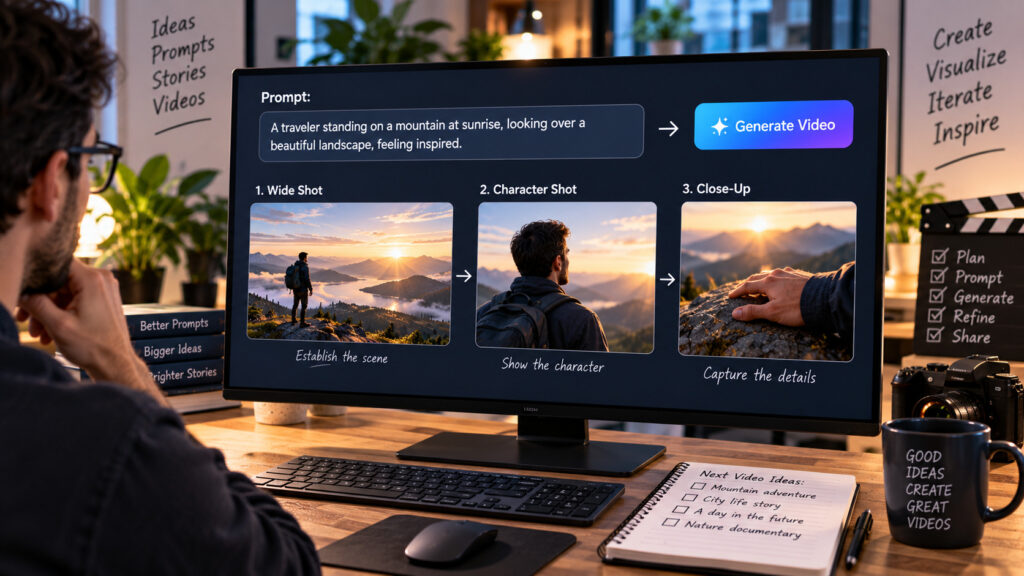
Good AI Video Prompts Think in Scenes
For example, instead of:
“Create a futuristic city.”
A creator might specify a cinematic establishing shot of a dense coastal city at sunrise, with autonomous vehicles moving quietly through the streets, pedestrians reflected in wet pavement, soft atmospheric haze, slow forward camera movement and subtle environmental sound.
The additional detail gives the model creative constraints.
But there is another important lesson:
Longer doesn’t automatically mean better.
The goal is not to write the longest prompt possible.
The goal is to communicate the scene clearly.
AI Video Is Changing Advertising
Marketing may become one of the biggest beneficiaries of generative video.
Advertising depends heavily on experimentation.
Teams test:
Different hooks.
Different scenes.
Different products.
Different voices.
Different audiences.
Different versions of the same idea.
Traditional production makes experimentation expensive.
If producing each variation requires a new shoot, companies naturally limit how many concepts they test.
AI can change that economics.
A brand could potentially prototype several visual directions before choosing which concept deserves a traditional production budget.
Smaller businesses may also gain access to video styles that were previously beyond their budgets.
The result could be an explosion of creative advertising experimentation.
But More Content Doesn’t Automatically Mean Better Advertising
There is an obvious danger.
If everyone can generate hundreds of advertisements, the internet could simply become noisier.
Quantity isn’t strategy.
A mediocre idea generated 50 times is still a mediocre idea.
Brands still need:
A compelling message.
Clear positioning.
An understanding of the audience.
Trust.
Taste.
Creative judgment.
AI can accelerate execution, but it doesn’t automatically provide those things.

AI Video Is Also Changing Entertainment
Generative video opens interesting possibilities beyond advertising.
Independent filmmakers can prototype scenes before filming.
Musicians can experiment with visual concepts.
Game developers can visualize environments.
Writers can turn story concepts into visual mood pieces.
Creators can build fictional worlds without having access to Hollywood-scale production resources.
That democratization could produce genuinely original work.
But it could also flood platforms with repetitive AI-generated content.
The difference will increasingly come down to creative direction.
When everyone has access to powerful generation technology, the idea becomes more valuable than the ability to generate.
Can You Make Money From AI-Generated Videos?
This is one of the most common questions creators ask.
AI-generated content can potentially be used in commercial content, but there isn’t a universal rule that says every AI video can automatically be monetized everywhere.
Several separate questions matter:
What are the terms of the AI tool you’re using?
Do you have the appropriate rights to the assets involved?
Does your content comply with the platform’s policies?
Are you impersonating someone?
Are you misleading viewers?
Does the platform require AI disclosure?
Does the content add genuine creative value?
For YouTube specifically, the platform says that applying its AI disclosure label by itself does not reduce audience reach or monetization eligibility.
That’s an important distinction.
Disclosure does not automatically mean punishment.
YouTube’s AI Disclosure Rules Matter in 2026
As AI video becomes more realistic, transparency becomes increasingly important.
YouTube requires creators to disclose AI-generated or meaningfully altered content when it appears realistic in certain circumstances.
Examples include making a real person appear to say or do something they didn’t, altering footage of a real event or place, or generating a realistic event that never occurred.
YouTube’s 2026 update also made AI labels more prominent.
For Shorts, the label can appear directly as an overlay on the video. For long-form content, the disclosure can appear below the player.
This is particularly relevant to Veo creators because realistic AI video is becoming harder to distinguish from conventional footage.
Not Every Use of AI Requires the Same Disclosure
YouTube makes an important distinction between meaningful realistic generation and minor production assistance.
According to its current guidance, things such as using AI to help create an outline, script, thumbnail, title or infographic do not necessarily require the same disclosure.
Minor aesthetic edits such as certain lighting or color adjustments are also treated differently from realistic synthetic scenes that could mislead viewers.
So saying simply:
“YouTube requires every AI-assisted video to carry an AI warning”
would be inaccurate.
The context and nature of the AI use matter.
YouTube Can Also Detect AI Provenance
Another development worth watching is content provenance.
YouTube says it may automatically apply AI-related labels in some circumstances, including content created with YouTube’s own generative AI tools and content carrying certain C2PA metadata.
C2PA is part of a broader effort to attach verifiable information about the origin and editing history of digital media.
This could become increasingly important as the internet fills with synthetic media.
The question may gradually shift from:
“Does this look real?”
to:
“Can we verify where this came from?”
The Deepfake Problem Isn’t Going Away
The same technology that can create a fictional cinematic scene can also be misused.
A realistic synthetic video could make someone appear to say something they never said.
It could depict an event that never happened.
It could imitate a person’s appearance or voice.
That creates obvious risks for fraud, harassment, misinformation and reputation.
YouTube already provides a privacy complaint process for realistic AI-generated or synthetic content that looks or sounds like an identifiable person. The platform says it considers factors including realism, disclosure, identifiability, public-interest context and whether a public figure is depicted engaging in sensitive behavior.
YouTube’s impersonation rules also prohibit using someone’s AI-generated likeness or voice to falsely suggest that they own or authorize a channel’s content.
As generation improves, these safeguards will become increasingly important.
Will AI Video Replace Traditional Filmmaking?
Probably not in the simplistic way people sometimes imagine.
Photography didn’t eliminate painting.
Digital cameras didn’t eliminate professional photography.
Smartphones didn’t eliminate cinema cameras.
AI video is likely to become another creative medium.
Some projects will be almost entirely generated.
Others will combine real footage and AI.
High-end productions may use AI for previsualization, backgrounds, effects or specific sequences while retaining traditional actors and cameras.
And some creators may deliberately emphasize authentic, camera-captured footage precisely because synthetic content has become so common.
In fact, YouTube already has a “Captured with a camera” disclosure based on content-provenance technology for qualifying footage.
That’s a fascinating sign of where media could be heading.
We used to label what was artificial.
In a world saturated with AI, we may increasingly label what can be verified as authentic.
What Veo 3 Means for Creators
The biggest opportunity isn’t simply:
“Generate lots of AI videos.”
It’s learning how to combine AI with genuine creativity.
A creator still needs to understand:
Storytelling.
Hooks.
Pacing.
Audience psychology.
Editing.
Sound.
Brand identity.
Distribution.
AI can generate a beautiful eight-second scene.
It cannot guarantee that anyone will care about it.
The creators who stand out will probably be those who treat generative video as a creative instrument rather than an automatic content machine.
What Veo Means for Businesses
For companies, the opportunity is slightly different.
AI video can reduce the cost of experimentation.
A business could use it to prototype:
Product concepts.
Advertising ideas.
Training content.
Explainer videos.
Social campaigns.
Storyboards.
Localization concepts.
Visual demonstrations.
Instead of spending a large budget before knowing whether an idea works, teams can visualize concepts earlier.
That could make creative production faster and more iterative.
The Internet May Become Much More Visual
For decades, creating text was easier than creating professional video.
Anyone could write a paragraph.
Producing a convincing cinematic sequence required significantly more resources.
Generative video narrows that gap.
When producing a visual scene becomes almost as accessible as describing one, the volume of video online could increase dramatically.
This has consequences for creators.
Simply having technically impressive visuals won’t be enough.
When everyone can generate beautiful footage, audiences will place more value on:
Original ideas.
Personality.
Trust.
Storytelling.
Expertise.
Humor.
Authenticity.
Community.
Technology raises the baseline.
Creativity determines who rises above it.
Frequently Asked Questions About Google Veo 3
What is Google Veo 3?
Veo 3 is part of Google’s generative video model family. Google introduced Veo 3 with capabilities including native audio generation alongside video, and the technology has since progressed to Veo 3.1.
What is the latest version of Veo?
As of August 2026, Google publicly presents Veo 3.1 as its latest Veo generation.
Can Veo generate sound?
Yes. Native audio is one of the major capabilities Google highlighted with Veo 3, including dialogue, background audio and sound effects.
Can Veo generate vertical videos?
Veo 3.1’s updated Ingredients to Video functionality supports native 9:16 vertical generation, which Google specifically positions for mobile-first formats such as YouTube Shorts.
Can Veo generate 4K video?
Google says its January 2026 Veo 3.1 update added improved 1080p and 4K upscaling capabilities.
Does YouTube allow AI-generated video?
AI-generated content can appear on YouTube, but it remains subject to YouTube’s broader policies. Realistic content that has been meaningfully generated or altered using AI may require disclosure.
Does labeling a YouTube video as AI-generated hurt monetization?
YouTube says that applying the AI disclosure label alone does not affect monetization eligibility or audience reach.
Final Thoughts

Google Veo represents something larger than another generative AI product.
It shows how quickly the boundary between imagining a scene and producing one is shrinking.
Veo 3 brought together video and native audio generation. Veo 3.1 has pushed further into consistency, vertical content and higher-quality output.
For creators, that means unprecedented freedom to experiment.
For businesses, it means faster and potentially cheaper visual prototyping.
For social platforms, it means a flood of new synthetic media.
And for viewers, it creates a new challenge: understanding what is real, what is generated and whether that distinction matters in the context of what they’re watching.
AI video will almost certainly become more capable from here.
But the biggest competitive advantage won’t necessarily belong to the person with access to the newest model.
It will belong to the person who knows what story is worth telling with it.