Artificial intelligence in business is entering a new phase. For the past few years, most companies have experienced AI through chatbots and generative tools capable of writing emails, summarizing documents, creating images or answering questions. These tools have already changed how people work, but they still depend heavily on humans to provide instructions and carry out the next step.

AI agents are beginning to change that relationship. Instead of simply generating an answer, an AI agent can be designed to understand an objective, analyze available information, decide what needs to happen next and interact with approved business tools to complete parts of a workflow. This evolution is one of the reasons AI agents for business have become such an important technology topic in 2026.
Consider a simple example. A traditional AI assistant might write a follow-up email for a potential customer. An AI sales agent could potentially analyze information about the prospect, examine previous interactions, prepare the email, update the CRM, suggest an appropriate follow-up date and present the salesperson with the actions that require approval. The difference is not simply better text generation. It is the transition from generating information to participating in work.
This does not mean companies should give artificial intelligence unlimited control over their systems. Successful agentic automation depends on clear objectives, carefully controlled permissions, reliable data, monitoring and human oversight. Understanding this balance is essential for any organization considering AI agents.
What Are AI Agents for Business?
An AI agent is a software system designed to pursue a defined objective using artificial intelligence and a set of permitted resources. Depending on its design, an agent may be able to interpret information, reason about possible actions, use external tools, observe the results and determine what should happen next.
Imagine a company asking an AI system to prepare its weekly sales report. A conventional chatbot might explain how to create the report or analyze information manually provided by an employee. An agent connected to approved systems could potentially retrieve relevant sales data, compare it with previous periods, identify unusual changes, organize the findings and prepare a report for human review.
This ability to interact with business systems is what makes agents particularly interesting. The AI is no longer isolated inside a chat window. It can become part of a larger workflow involving databases, CRM platforms, calendars, internal knowledge bases, analytics systems and other applications.
However, an AI agent should not be confused with an independent digital employee capable of doing anything. Real business agents operate within boundaries. The company determines which data the agent can access, which tools it can use and which actions require human authorization.
AI Agents vs Chatbots vs Traditional Automation
Understanding the difference between these technologies is important because businesses do not need an AI agent for every task.
Traditional automation works extremely well when a process follows predictable rules. If a customer completes a form, for example, an automation can create a CRM record and send a confirmation email. The workflow does not need to reason about the situation because the sequence is already known.
Chatbots introduce intelligence into the interaction. They can understand natural language, answer questions, summarize information and generate content. Nevertheless, the user normally remains responsible for deciding what to do with the answer.
AI agents add another layer: goal-oriented execution. An agent can potentially determine which steps are necessary to achieve an objective and interact with permitted tools to perform those steps. Instead of merely telling an employee what could be done, it can assist with actually carrying out the workflow.
The three technologies are therefore complementary rather than mutually exclusive. A sophisticated business workflow might use traditional automation for predictable tasks, AI for interpretation and reasoning, and human employees for important decisions.
How Do AI Agents Work?
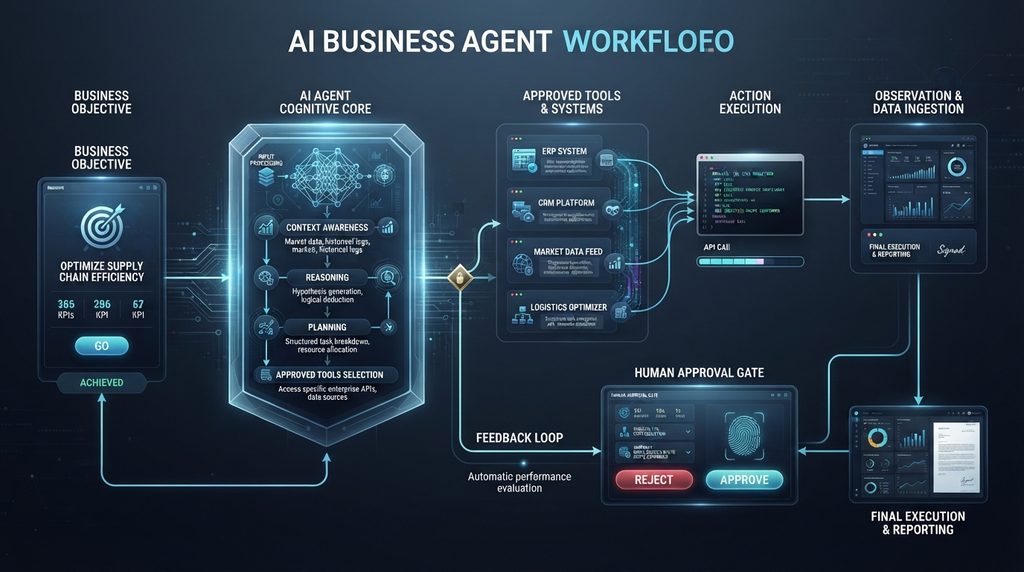
Most AI agents can be understood through a relatively simple cycle. The process begins with a goal. The agent receives an objective such as analyzing customer complaints, preparing a report or organizing incoming leads.
The AI then evaluates the information available to it and determines what actions may be necessary. Depending on the architecture, it may have access to specific tools such as a CRM, database, calendar, search system or internal application. The agent selects an appropriate action, observes the result and uses that new information to determine the next step.
This process may repeat several times until the task reaches a completion condition or requires human intervention. In a properly designed business environment, the agent does not have unlimited permissions. Its available actions are deliberately restricted according to its role.
An AI support agent, for example, might be allowed to search the company’s documentation and prepare responses but prohibited from issuing refunds above a certain amount without approval. A financial reporting agent might be allowed to read transaction data but not modify it.
This combination of intelligence and controlled access is what turns a language model into a practical business agent.
AI Agents for Customer Support
Customer support is one of the most natural applications for business agents because companies receive large volumes of repetitive questions. Traditional chatbots can already answer basic FAQs, but an agent can potentially participate in a broader support workflow.
Suppose a customer contacts an ecommerce store because an order has not arrived. A properly integrated support agent could identify the customer, retrieve permitted order information, check the shipment status, consult the company’s support policy and prepare an appropriate response. If the situation falls outside predefined boundaries, it could escalate the case to an employee with the relevant context already organized.
This approach can reduce repetitive work without eliminating human support. Employees can concentrate on unusual, sensitive or high-value situations while AI handles routine information retrieval and preparation.
The quality of the underlying knowledge base remains extremely important. An intelligent agent connected to inaccurate or outdated company information can simply produce incorrect answers more efficiently. Companies therefore need to improve their information architecture alongside their AI systems.
AI Agents for Sales
Sales teams spend a surprising amount of time on activities that are not direct selling. They research prospects, update CRM records, prepare meeting notes, write follow-up messages and analyze pipelines.
An AI sales agent can assist with these activities. Before a meeting, for example, the agent could collect permitted information about the prospect, summarize previous conversations and prepare a short briefing for the salesperson. After the meeting, it could organize notes, draft a follow-up message and recommend the next action.
The salesperson remains responsible for the relationship and important commercial decisions, but much of the administrative workload can be reduced.
A more advanced agent could also analyze the sales pipeline and highlight opportunities that appear to require attention. Instead of manually reviewing hundreds of CRM records, a manager might receive a concise summary of important changes and potential risks.
The business value does not come from saying, “We have an AI sales agent.” It comes from reducing administrative work and allowing salespeople to spend more time speaking with customers.
AI Agents for Marketing
Marketing involves constant coordination between research, content, campaigns, analytics and customer behavior. Because information changes continuously, it can become difficult for a small team to monitor everything effectively.
An AI marketing agent could analyze campaign performance, identify significant changes and prepare recommendations for human review. If advertising costs suddenly increase while conversions decline, the system could highlight the anomaly and provide relevant context instead of requiring a marketer to discover it manually several days later.
Agents can also assist with content operations. One agent might monitor customer questions and identify potential content topics, while another organizes performance information from existing articles. The marketing team can then use those insights to decide what deserves to be created or updated.
This is where AI agents connect naturally with AI content creation. Rather than using artificial intelligence simply to generate more articles, businesses can use it to build a more intelligent content system based on research, audience needs and performance data.
AI Research Agents
Research is another area where agentic systems can provide significant value. Businesses constantly need information about competitors, markets, products, customers and emerging trends.
A research agent can be configured to gather information from approved sources, organize it around a business question and prepare a structured summary. Instead of giving a manager dozens of disconnected links, the system can help transform information into something easier to analyze.
Imagine an ecommerce company trying to understand why customers dislike a particular category of products. A research workflow could analyze a permitted collection of reviews, group recurring complaints and identify patterns. Human decision-makers can then evaluate those findings before changing products or marketing strategies.
Research agents are especially useful when the challenge is not a lack of information but an overwhelming amount of it.
AI Agents for Ecommerce
Ecommerce businesses generate enormous quantities of operational data. Product catalogs, orders, reviews, inventory, customer questions, advertising campaigns and returns all produce information that needs to be monitored.
An ecommerce agent could analyze customer reviews and identify recurring complaints about specific products. Another could monitor inventory and highlight products at risk of running out. A support agent could handle common order questions, while an analytics agent could summarize changes in sales performance.
The goal is not to create an ecommerce store controlled entirely by artificial intelligence. It is to create a system where AI continuously monitors repetitive information and directs human attention toward the situations that matter most.
For small ecommerce teams, this could be particularly valuable because employees often perform several roles simultaneously.
AI Agents for Business Analytics
Traditional dashboards are excellent at showing what happened. The next generation of AI analytics is increasingly focused on helping users investigate why something happened.
Imagine asking, “Why did our conversion rate decline last week?”
Answering that question manually may require examining website traffic, advertising campaigns, product availability, geographic performance and several other datasets.
An analytics agent could assist by examining permitted data sources, identifying meaningful changes and presenting possible explanations. The manager still evaluates the conclusion, but the time required to investigate the problem can be reduced dramatically.
This represents an important evolution in business intelligence. Instead of employees constantly navigating dashboards looking for problems, AI systems can increasingly help surface anomalies and direct attention toward them.

AI Agents for Operations
Operations may eventually become one of the most important applications of agentic AI because businesses rely on many interconnected processes.
A company might have orders arriving from one system, customer complaints in another, inventory information elsewhere and financial reports in another platform. Employees are often responsible for manually connecting these pieces of information.
An operations agent could monitor approved systems and identify situations requiring attention. It might detect delayed orders, unusual costs, inventory problems or sudden increases in customer complaints.
This changes the relationship between employees and business software. Instead of constantly asking different systems what happened, a manager could increasingly ask a single question: “What requires my attention today?”
The AI would not make every decision. Its role would be to monitor complexity and surface useful information.
AI Agents for Small Businesses
Large corporations have enormous AI budgets, but small businesses may have an important advantage: simplicity.
A company with ten employees can often identify and modify a workflow much faster than an organization with 50,000 employees. This makes targeted AI agents for small business particularly interesting.
Consider a small real-estate agency. It might receive leads from its website, social media and advertising campaigns. Employees manually review each inquiry, determine what type of property the person wants and decide which agent should respond.
A carefully designed AI workflow could classify those leads, organize their information, prepare responses and notify the appropriate salesperson. Human agents remain responsible for the customer relationship, but repetitive administrative work becomes easier.
The company does not need twenty AI agents. One useful agent solving one expensive problem can be enough to generate meaningful value.
This is also why entrepreneurs exploring AI business ideas may find opportunities in building specialized agents for specific industries rather than creating another general-purpose AI platform.
Single AI Agents vs Multi-Agent Systems
As workflows become more complex, companies may choose to use several specialized agents instead of one system responsible for everything.
A marketing agent could focus on campaign performance. A sales agent could focus on leads. A research agent could collect competitive intelligence. An analytics agent could investigate business data. A supervisory layer could coordinate information between them where appropriate.
This architecture is known as a multi-agent system.
The idea resembles a team of specialists. Each agent has a defined role, specific tools and limited permissions. This can be easier to control than giving one extremely powerful agent access to every system in the company.
Multi-agent systems can also create more modular workflows. If one component needs to be improved or replaced, the entire system does not necessarily need to be rebuilt.
However, more agents also create more complexity. Businesses need monitoring, clear communication protocols, security controls and methods for resolving conflicting outputs.
The goal should therefore never be to deploy as many agents as possible. The objective is to design the simplest system capable of solving the problem reliably.
AI Agents and Traditional Automation Should Work Together
Agentic AI does not make traditional automation obsolete.
In fact, some of the strongest business systems will combine both.
Imagine a successful payment. The system does not need artificial intelligence to decide whether to generate an invoice. A deterministic automation can perform that action more reliably.
Now imagine a customer sends an unstructured message explaining a complicated problem. The system may need to understand what the person wants before determining the correct workflow. That is where AI becomes useful.
A good rule is therefore simple: use traditional automation when the process is predictable, use AI when interpretation or reasoning adds value, and involve humans when judgment or accountability is required.
This approach also reduces unnecessary complexity and cost.
Human-in-the-Loop AI
One of the most important concepts in business AI is human-in-the-loop.
Not every action should be executed automatically simply because an agent is technically capable of doing it.
Low-risk actions may be highly automated. An AI agent might categorize documents or summarize internal information without requiring approval every time.
Other actions deserve a checkpoint. The agent might prepare a customer refund, contract modification or external communication but wait for an employee to approve it.
High-impact decisions involving significant money, legal commitments, sensitive personal information or security permissions should generally have much stronger controls.
The ideal level of autonomy therefore depends on the consequences of an error.
The question businesses should ask is not, “Can we automate this?”
It is:
“How much autonomy is appropriate for this specific decision?”
That distinction is critical.
Security and AI Agents
Security becomes significantly more important when AI moves from reading information to taking actions.
A chatbot that generates an incorrect sentence can cause confusion. An agent with permission to modify customer records, send external messages or interact with financial systems can create much larger consequences.
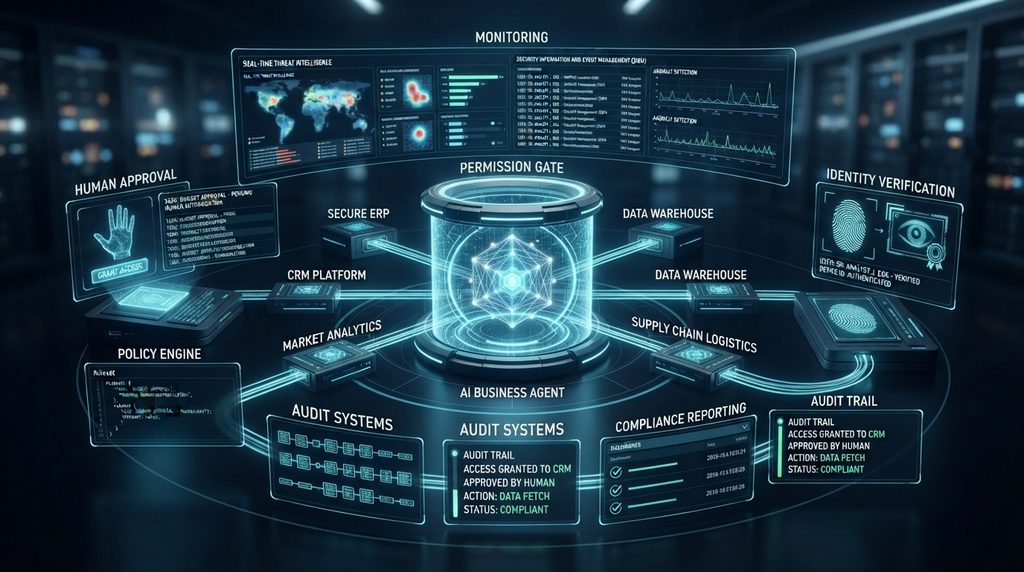
Every business agent should therefore have a clear identity and defined permissions.
An agent responsible for analyzing sales should not automatically receive access to employee medical records. A customer-support agent that needs to read order information does not necessarily need permission to delete orders.
This leads to one of the most important security principles for AI agents: least privilege.
Give the agent only the access required to perform its job.
Data Privacy and Governance
AI agents may interact with sensitive company information, making data governance another critical requirement.
Before deploying an agent, businesses should know exactly what information it can access, where that information is processed and whether it should be retained.
Companies should also understand which external services are involved in the workflow. Connecting an AI system to customer data without understanding how that data is handled can create unnecessary privacy and compliance risks.
Logging is equally important. When an agent performs an important action, the business should ideally be able to determine what happened and why.
As agentic systems become more capable, governance will become part of the technical architecture rather than an administrative afterthought.
How to Implement AI Agents in Your Business
The best way to start is not by buying dozens of AI tools. Start by identifying one expensive or repetitive workflow.
Observe how employees currently perform that task. Document each step, the applications involved and the points where delays or errors occur.
Then separate the workflow into different types of work. Some steps may be predictable and should use traditional automation. Others may require interpretation and could benefit from AI. Sensitive decisions may remain under human control.
Once this map exists, create a limited pilot. Give the agent only the tools and permissions necessary for that workflow.
Run it on a small scale and measure what happens.
Does it save time?
Does it make mistakes?
How frequently does it need human assistance?
Are employees actually using it?
Does the output create measurable value?
Only after answering these questions should the system be expanded.
This incremental approach is much safer than attempting to transform the entire company at once.
Measuring the ROI of AI Agents
Businesses should measure AI agents according to business outcomes rather than technical sophistication.
Imagine an administrative process consumes 120 employee hours every month. After introducing an agentic workflow, employees spend only 45 hours handling exceptions and reviewing important cases.
The company has recovered 75 hours of capacity.
That does not automatically mean the project is profitable. The calculation must also include AI usage costs, software subscriptions, implementation, maintenance, monitoring and employee training.
A simple way to think about return on investment is:
ROI = (Value Created − Total Cost) ÷ Total Cost × 100
Value created may include time saved, additional sales capacity, faster customer response, fewer errors or improved operational efficiency.
This is also why every AI project should have a measurable objective before implementation begins.
“Use AI” is not an objective.
“Reduce average support resolution time while maintaining customer satisfaction” is much more useful.
When Businesses Should Not Use AI Agents
AI agents are powerful, but they are not always the correct solution.
If a process can be handled reliably with a simple automation, adding an AI agent may introduce unnecessary complexity.
If the workflow itself is badly designed, automating it can simply make a broken process run faster.
If accurate data is unavailable, an agent may struggle to produce reliable results.
And if an action can create serious financial, legal or safety consequences, unrestricted autonomy may be inappropriate.
Sometimes the best business automation is intentionally simple.
Reliability matters more than novelty.
The Agentic Enterprise
The long-term significance of AI agents goes beyond individual productivity.
Businesses have traditionally been organized around people using software. Employees open applications, search for information, interpret results and manually transfer data between systems.
Agentic systems introduce another possibility.
Humans can increasingly define goals and supervise outcomes while specialized AI systems coordinate some of the execution between applications.
This does not necessarily mean businesses without employees. It means the division of work between humans and software can change.
People remain particularly valuable for judgment, creativity, relationships, accountability and strategic decisions. AI agents can take responsibility for portions of repetitive information processing and execution.
The resulting organization could operate more like a network of human specialists and digital agents working together.

The Future of AI Agents for Business
The next stage of AI adoption is likely to involve more specialized agents, deeper integration with business applications and stronger governance.
Instead of one general assistant attempting to perform every task, companies may operate networks of specialized systems. A sales agent understands the CRM. A support agent understands the knowledge base. An analytics agent understands company metrics. An operations agent monitors workflows.
Humans could increasingly become supervisors of these systems, defining objectives and resolving situations requiring judgment.
This transition will also create new professions and business opportunities. Companies will need people capable of designing agent workflows, integrating systems, evaluating performance, securing permissions and deciding where human approval is necessary.
The companies that gain the most from AI may therefore not be those that simply buy the largest number of tools. They may be those that redesign workflows intelligently around the strengths of both humans and machines.
Frequently Asked Questions About AI Agents for Business
What are AI agents for business?
AI agents for business are AI-powered systems designed to pursue defined business objectives by analyzing information, reasoning about tasks and interacting with permitted tools or workflows. Unlike a basic chatbot, an agent can potentially participate in completing multi-step processes.
What is the difference between an AI agent and a chatbot?
A chatbot primarily communicates with users and generates responses. An AI agent can potentially plan actions and interact with approved tools to help complete an objective. The level of autonomy depends on how the system is designed.
Can small businesses use AI agents?
Yes. Small businesses can start with a narrow workflow such as lead qualification, customer-support triage, research, reporting or internal knowledge retrieval. They do not need a complex multi-agent infrastructure to benefit from the technology.
Can AI agents replace employees?
AI agents can automate or assist with parts of jobs, especially repetitive information-processing tasks. Human employees remain important for judgment, relationships, strategy, exceptions and accountability.
Are AI agents safe?
Their safety depends heavily on implementation. Agents that can interact with tools require controlled permissions, secure identities, monitoring and human approval for sensitive actions.
What is agentic AI?
Agentic AI describes systems capable of pursuing goals and participating in multi-step workflows rather than simply responding to individual prompts.
What is a multi-agent system?
A multi-agent system uses several specialized agents that cooperate or coordinate around a larger workflow. Each agent can have its own role, tools and permissions.
How can a company start using AI agents?
The best starting point is usually one clearly defined repetitive workflow. Map the existing process, identify where AI adds value, establish permissions and human approval rules, test a small pilot and measure the results before expanding.
Conclusion: From AI That Answers to AI That Acts
The evolution of AI agents for business represents a fundamental change in how companies can use artificial intelligence.
The first wave of generative AI focused largely on creating things: text, images, summaries, presentations and code. AI agents extend that capability toward execution.
A support agent can help investigate customer requests. A sales agent can organize opportunities. A research agent can analyze large quantities of information. An analytics agent can investigate changes in business performance. An operations agent can continuously monitor workflows and identify what deserves human attention.
But the most important lesson is that greater capability requires greater control.
The goal should not be maximum autonomy.
The goal should be useful, measurable and responsible automation.
A strong business agent has a clear objective, access only to the tools it needs, defined limits, monitoring and human approval wherever the consequences justify it.
The future of business automation is therefore unlikely to be humans competing against AI. A more realistic and powerful model is humans directing intelligent systems while those systems handle increasingly complex portions of execution.
Companies that learn how to design that relationship effectively may gain a significant advantage as agentic AI continues to mature.
The question for businesses in 2026 is no longer simply:
“What can AI generate for us?”
It is increasingly becoming:
“Which parts of our workflow can AI responsibly help us execute?”
And that may be the question that defines the next era of business automation.