Over the last decade, television has undergone one of the biggest transformations in its history. Traditional cable and satellite packages are no longer the only ways to watch television. Millions of viewers now consume live channels, movies, series and other video content through internet-connected televisions, smartphones, tablets, computers and streaming devices.
At the center of this transformation is IPTV, or Internet Protocol Television. Instead of delivering television through traditional terrestrial broadcasts, satellite signals or conventional cable networks, IPTV uses internet protocol networks to deliver video content to compatible devices.

This flexibility has made IPTV increasingly important in the modern streaming industry. However, its popularity has also created confusion. One of the most common questions consumers ask is simple: Is IPTV legal?
The answer depends primarily on authorization and licensing. IPTV technology can be used perfectly legally. Problems arise when copyrighted television channels, movies, sports broadcasts or other protected content are distributed without permission from the relevant rights holders. Government and intellectual-property authorities make the same distinction between legitimate streaming technology and unauthorized access to protected content.
Understanding that difference is essential for anyone considering an IPTV or internet television service.
What Is IPTV?
IPTV stands for Internet Protocol Television. It describes systems that deliver television programming using IP networks rather than traditional broadcasting technologies.
The underlying concept is relatively straightforward. Video content is transmitted digitally from a source or server through a network to a compatible application or device. Depending on the service, viewers may receive live television, video on demand, catch-up programming or other interactive features.
IPTV can therefore support several different viewing experiences. A viewer might watch a live news channel, select a movie from an on-demand catalogue or continue watching a program on another compatible device.
This is one reason IPTV should not automatically be associated with piracy. The European Union Intellectual Property Office describes IPTV as the delivery of television content over IP networks and separately defines IPTV piracy as illegal distribution of television, film and live sports content using similar technical means.
That distinction is fundamental.
How IPTV Works
When you select a program through an IPTV-compatible service, your request is processed through a network infrastructure. The requested video is delivered as digital data and reconstructed by your application or device for playback.
The exact architecture varies considerably between providers. Services may use content delivery networks, authentication systems, applications, subscriber accounts and technologies such as Digital Rights Management.
DRM is particularly important in legitimate digital distribution because it helps rights holders and platforms control access to copyrighted content. EUIPO explains that DRM technologies can authenticate users, control access and help protect digital material against unauthorized distribution.
For consumers, the result can feel similar to ordinary streaming: choose something to watch, press play and receive the content over an internet connection.
Internet television also makes multi-device viewing possible. Depending on the provider and subscription, content may be accessible through Smart TVs, streaming boxes, smartphones, tablets and computers.
Is IPTV Legal in 2026?
Yes — IPTV technology itself can be completely legal.
The more important question is whether a particular provider has authorization to distribute the content it offers in the territories where that content is being supplied.
Copyright holders generally control how protected movies, television programs and broadcasts can be reproduced, distributed and communicated to the public. Using copyrighted material without authorization can constitute infringement unless a relevant legal exception applies.
Consequently, two services can use technically similar IPTV systems while having completely different legal positions.
One may have agreements allowing it to distribute the channels and programming included in its service. Another may retransmit the same protected material without authorization.
The technology does not determine legality. Content rights and authorization do.
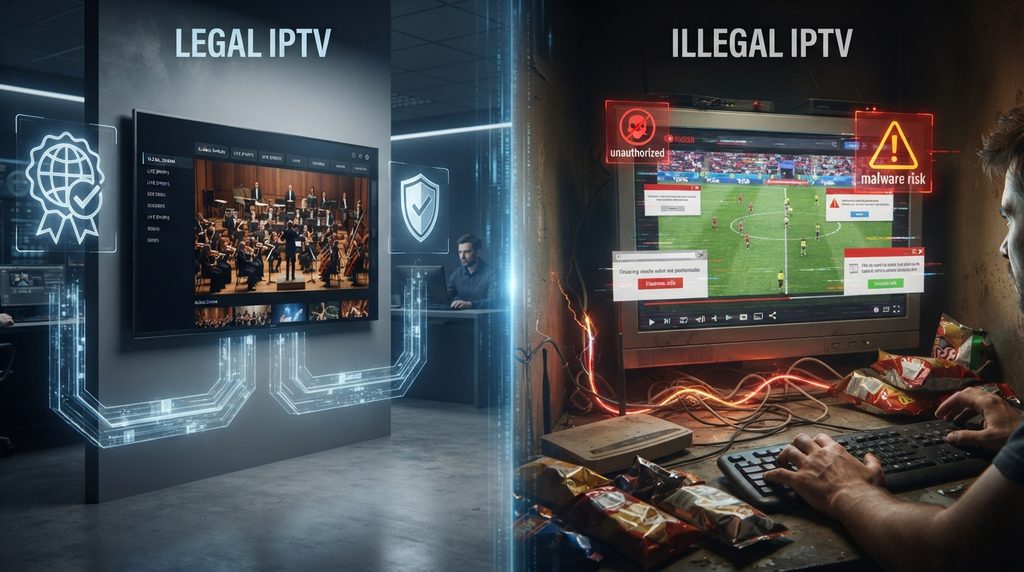
Legal IPTV vs. Illegal IPTV
Understanding this distinction makes evaluating an IPTV service much easier.

A legitimate internet television service should have authorization for the protected content it distributes. Consumers should also expect transparent information about the company, subscription terms, payment arrangements and service conditions.
An unauthorized IPTV operation, by contrast, may retransmit premium television, movies or sporting events without obtaining the necessary rights.
Official UK guidance makes this distinction particularly clear. Streaming devices themselves can be used legally for legitimate content, but using modified devices or applications to access paid protected content without the appropriate subscription or permission can constitute illicit streaming.
Therefore, consumers should avoid assuming that every service calling itself “IPTV” is either legal or illegal.
The label tells you about the delivery technology, not necessarily the licensing status.
Why Licensing Matters
Television programming involves an extensive ecosystem of intellectual-property rights.
Movies, series, sporting events and television broadcasts can involve producers, studios, broadcasters, sports organizations and other rights holders. Distribution agreements can also vary by country.
A company may therefore have permission to distribute certain programming in one market but not another.
This territorial dimension is one reason consumers should be cautious about simplistic claims such as “every channel worldwide is automatically legal everywhere.”
Legitimate distribution depends on the actual rights associated with the content and territory.
Copyright law also gives rights holders significant control over how their works are used. UK Intellectual Property Office guidance, for example, explains that permission or an appropriate licence is generally required to use another person’s copyrighted material unless a legal exception applies.
Risks of Illegal IPTV Services
Unauthorized IPTV services can create problems extending beyond copyright.
One obvious concern is legal exposure. Rules vary considerably between jurisdictions, but authorities in multiple countries actively investigate illegal streaming networks and unauthorized commercial distribution.
There can also be cybersecurity concerns. Unregulated websites and applications may not provide the same security standards expected from established digital services.
UK government consumer guidance warns that illegal streaming applications and services can expose users to malware, fraud and data theft, particularly when payment information is provided to unregulated websites.
Reliability is another concern. An unauthorized operation may disappear unexpectedly, change domains, lose access to streams or provide little meaningful customer support.
Consumers should therefore evaluate much more than the number of channels advertised by a provider.
How to Choose a Safe IPTV Service
When evaluating an IPTV or streaming provider, transparency should be one of your priorities.
Look at what the company actually tells customers about itself. Read its terms and conditions, privacy policy, refund policy and information about content availability. If a company makes claims about licensing, partnerships or distribution rights, those claims should ideally be specific enough to verify.
You should also consider how payments are processed and what customer support is available.
A professional-looking website alone does not establish that a provider has broadcasting rights. Likewise, an application appearing on a particular device does not automatically prove that every stream delivered through it is authorized.
Consumers should evaluate the provider and its rights to the content, not merely the underlying player or technology.
For additional consumer information, the EUIPO maintains copyright guidance explaining what European consumers should consider when accessing copyrighted material online.
Are Very Cheap IPTV Subscriptions Illegal?
Price alone cannot establish whether a service is legal.
A low price may result from a promotion, limited content package, regional pricing or another legitimate business decision. Conversely, an expensive subscription is not automatically licensed simply because it costs more.
The better question is whether the provider is authorized to distribute what it sells.
A particularly strong reason for caution would be a service promising access to large amounts of premium subscription content from unrelated rights holders without explaining how that content is licensed.
Consumers should therefore focus on verifiable authorization and transparency rather than using price as the sole test.
IPTV Laws Around the World
There is no single worldwide IPTV law.
Copyright legislation, enforcement procedures and consumer liability differ between countries. What remains broadly important is the principle that protected content cannot simply be commercially redistributed without the necessary rights.
In the European Union, unauthorized IPTV distribution has become a significant anti-piracy concern. EUIPO research specifically distinguishes legitimate IPTV technology from IPTV piracy and reports continued challenges involving unauthorized access to television, film and live sports content.
In the United Kingdom, authorities have similarly published guidance concerning illicit streaming devices and unauthorized access to subscription content.
Consumers travelling or moving between countries should therefore avoid assuming that rules, licences or content availability are identical everywhere.
IPTV, Smart TVs and Streaming Applications
Modern television hardware has helped accelerate the transition toward internet-delivered entertainment.
Smart TVs can run streaming applications directly. Other televisions can gain similar capabilities through external streaming devices.
But the application used to play a stream and the legal status of the content are separate questions.

A media player may be entirely legitimate software while being capable of opening streams supplied by many different sources. Consequently, installing an IPTV-compatible application does not automatically tell you whether a particular subscription or playlist is authorized.
Again, the relevant question is the source and distribution rights of the content.
The Role of Security and Privacy
Streaming platforms can process significant amounts of information, including account credentials, device information, viewing activity and payment data.
Before subscribing, users should therefore review the provider’s privacy practices and understand how their information is handled.
Secure payment processing and HTTPS are useful technical indicators, but they should not be confused with content licensing. A website can use encryption while still distributing unauthorized material.
Similarly, using a VPN does not transform unauthorized distribution into authorized distribution. Privacy technology and copyright authorization are separate issues.
The Future of Internet Television
Internet-delivered television will likely continue evolving as broadband connections, Smart TVs and streaming technologies improve.
Artificial intelligence is already influencing content discovery and personalization across digital entertainment. Recommendation systems can help users navigate enormous libraries and find programming aligned with their interests.
Video quality is also improving. Higher-resolution streaming, better compression technologies and more efficient content delivery infrastructure can provide increasingly sophisticated viewing experiences.
At the same time, rights holders and regulators are investing in anti-piracy technologies. EUIPO reports that live-event piracy remains a significant issue and identifies IPTV piracy as an important source of unauthorized retransmission.
The future of IPTV will therefore involve two developments happening simultaneously: better streaming technology for consumers and stronger mechanisms for protecting copyrighted content.
Frequently Asked Questions About Legal IPTV
Is IPTV legal?
Yes. IPTV is a television-delivery technology and can be used legally. Legality depends on whether the service has the necessary authorization for the content it distributes.
Is every IPTV subscription legal?
No. Different providers can operate under very different licensing arrangements. Consumers should verify claims rather than assuming legality based solely on the term IPTV.
Can IPTV be used on a Smart TV?
Yes. Many internet television services support Smart TVs directly or through compatible streaming devices and applications.
How can I identify a legal IPTV service?
Look for transparency about the company, content availability, subscription terms and licensing. Claims of authorization should ideally be verifiable.
Is cheap IPTV automatically illegal?
No. Price alone cannot determine legality. Content authorization is the key issue.
Are IPTV applications illegal?
An application capable of playing IPTV streams is not necessarily illegal. The source and authorization of the content being accessed matter.
Is using a VPN with IPTV illegal?
A VPN is a privacy/networking technology. Using one does not by itself determine whether content is legal, nor does it give a provider distribution rights it does not possess.
What are the risks of illegal IPTV?
Potential risks can include copyright issues, unreliable service and cybersecurity concerns such as malware, fraud or data theft.
Conclusion
IPTV has become an important part of the transition from traditional broadcasting toward internet-delivered television.
Its greatest advantage is flexibility. Internet protocols allow television and video services to reach a wide variety of connected devices while supporting live programming, on-demand libraries and increasingly personalized viewing experiences.
But consumers should remember one crucial principle: IPTV technology and IPTV content licensing are two different things.
IPTV itself can be perfectly legitimate. The legal issue arises when protected television channels, movies, sports or other content are retransmitted without the necessary authorization.
As internet television continues to develop, choosing transparent services and understanding content rights will become even more important. The safest approach is to verify the provider, understand what you are buying and use services authorized to distribute the content you want to watch.