Artificial intelligence is no longer just an experimental technology used for occasional questions or simple text generation. In 2026, AI assistants have become serious productivity platforms used for research, writing, programming, business analysis, education, content creation, automation, and increasingly complex professional workflows.
That evolution has made ChatGPT vs Claude vs Perplexity one of the most important comparisons for anyone trying to choose an AI assistant. All three platforms can answer questions, analyze documents, summarize information, generate content, and assist with professional tasks, but they are becoming increasingly different in the way they approach those jobs.
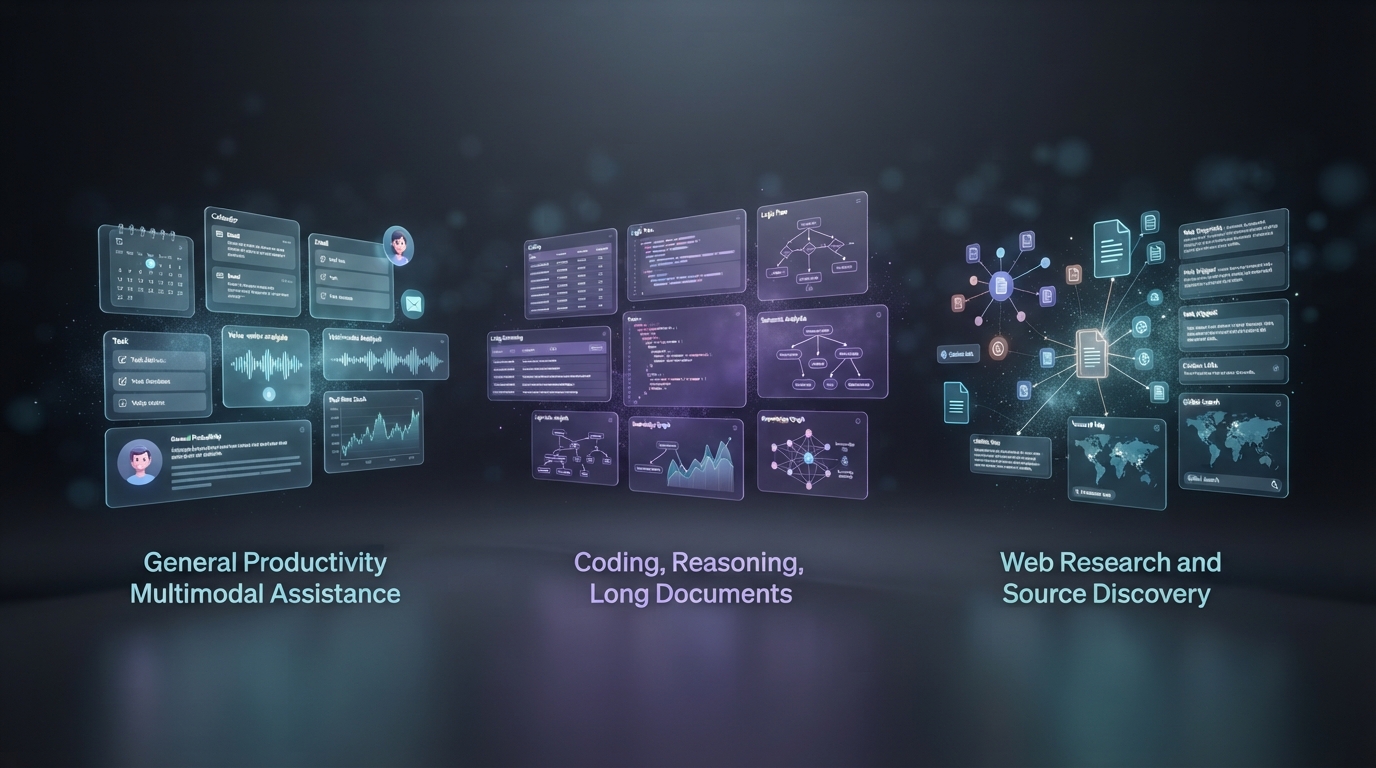
ChatGPT has developed into a broad, general-purpose AI workspace. Claude has built a strong reputation around sophisticated knowledge work, long-form writing, reasoning, coding, and agentic development. Perplexity has taken a research-first approach, combining artificial intelligence with web discovery and visible sourcing.
The real question, therefore, is no longer simply which AI produces the smartest answer. The better question is which platform provides the right combination of intelligence, reliability, tools, research capability, workflow integration, and ease of use for the work you actually need to accomplish.

Why ChatGPT vs Claude vs Perplexity Matters More in 2026
The AI industry has changed dramatically in only a few years. Early generative AI products were essentially conversational systems: users entered a prompt, waited a few seconds, and received a block of generated text.
Modern AI assistants are moving far beyond that model. They can work with large documents, interpret images, search the web, analyze files, generate and debug code, reason through multi-step problems, interact with external tools, and in some cases perform actions rather than simply explain how those actions should be performed.
This means the competition between AI companies has also changed. A powerful language model is important, but the model alone is no longer enough. Users increasingly expect a complete ecosystem that can understand context, preserve continuity, use tools intelligently, retrieve current information, analyze complex material, and transform an idea into a useful result.
For professionals, that difference is especially important. A marketer may want an AI assistant that can research competitors, identify positioning opportunities, generate campaign concepts, and transform the research into useful content. A developer may want an AI capable of understanding an existing project, finding bugs, editing files, and testing changes. A researcher may prioritize sources, evidence, and clear distinctions between verified information and interpretation.
That is why choosing the best AI assistant in 2026 requires looking beyond isolated benchmark scores.
ChatGPT: The Most Versatile AI Ecosystem
ChatGPT’s biggest strength is versatility. What originally became famous as a conversational chatbot has evolved into a much broader environment for interacting with artificial intelligence.
Users can move between writing, research, analysis, document processing, problem solving, planning, coding, and multimodal tasks while remaining inside the same ecosystem. This flexibility makes ChatGPT particularly attractive to users who do not have a single narrow use case.
A small-business owner, for example, could use ChatGPT to brainstorm a marketing strategy, analyze business information, improve an email, create a presentation outline, and investigate a technical problem in the same day. A student can move between explanations, study assistance, and document analysis. Developers can also combine ordinary conversations with more advanced coding workflows.
This breadth is one of the reasons ChatGPT increasingly resembles an AI workspace rather than a traditional chatbot.
What ChatGPT Does Particularly Well
ChatGPT performs well across a remarkably wide variety of tasks. It can simplify complicated concepts, organize large amounts of information, improve writing, analyze files, assist with programming, generate ideas, and support structured problem solving.
The advantage becomes clearer when a project involves several different stages. Imagine researching a business opportunity. The process might begin with market research, move into competitor analysis, continue with financial scenarios, and eventually result in a business plan, presentation, and marketing campaign.
Using a different AI application for every stage can introduce unnecessary friction. A broad AI ecosystem can keep more of that workflow in one place.
This does not necessarily mean ChatGPT is the strongest product in every individual category. Its advantage is that it can perform strongly across many categories without forcing the user to constantly change tools.
Claude: Designed for Serious Knowledge Work
Claude has become particularly popular among users dealing with complex instructions, substantial documents, programming projects, and demanding professional writing.
Its appeal becomes obvious when the task is not merely producing a quick response but understanding a larger body of information and maintaining consistency throughout a complex project.
Writers, developers, analysts, researchers, and professionals working with dense material can therefore find Claude particularly useful.
This explains why the Claude vs ChatGPT discussion has become increasingly important among advanced AI users. Both platforms are extremely capable, but their strongest use cases do not always overlap perfectly.
Claude for Long-Form Professional Writing
Generating grammatically correct sentences is relatively easy for modern AI. Producing a strong long-form document is considerably more difficult.
A useful writing assistant needs to understand context across multiple sections, preserve tone, avoid unnecessary repetition, maintain logical structure, and understand how individual paragraphs contribute to the overall argument.
Claude is particularly interesting for reports, analytical articles, business documents, research summaries, technical explanations, and heavy editorial revision.
The best use of AI writing, however, is not simply asking a model to generate thousands of words. Human editorial judgment remains essential. Someone still needs to decide which information matters, which claims require verification, what should be removed, and whether the final document genuinely serves the reader.
Claude and AI Coding Agents
Software development is one of the areas where artificial intelligence is moving fastest.
The first generation of AI-assisted programming usually involved copying a function into a chatbot and asking why it failed. Modern coding agents are becoming much more ambitious.
An AI coding agent can potentially examine several files, understand relationships between different parts of a project, trace dependencies, identify relevant code, make modifications, execute commands, inspect errors, and continue working toward a solution.
This fundamentally changes the relationship between developers and AI. Instead of functioning simply as a programming encyclopedia, AI begins participating directly in the development loop.
Claude’s growing role in coding and agentic development is therefore one of the reasons developers frequently compare it with OpenAI’s coding ecosystem.

Perplexity: Research at the Center of the Experience
Perplexity approaches artificial intelligence differently. Research and information discovery sit much closer to the center of the product.
A conventional search engine provides links and asks the user to decide which pages matter. An AI research engine attempts to find the relevant information, synthesize it, and present the sources behind the resulting answer.
This makes Perplexity particularly interesting for journalists, researchers, marketers, students, investors, publishers, and anyone whose work depends heavily on current information.
Why Sources Matter More Than Ever
Generative AI created a unique reliability problem. Modern AI systems can produce extremely convincing language even when a particular claim is incomplete or incorrect.
As generated writing becomes more fluent, confidence of presentation becomes a poor indicator of factual reliability.
That is why traceability matters. Users need the ability to identify where important information originated and verify it independently.
Perplexity’s research-first approach helps create this type of workflow by connecting generated answers with supporting sources.
However, citations should never be treated as an automatic guarantee of accuracy. An AI system can misunderstand a legitimate source, and the source itself might be outdated or incomplete. Important claims should always be verified against the original material.

ChatGPT vs Perplexity for Research
The difference between ChatGPT and Perplexity becomes especially interesting when research is the primary objective.
Perplexity naturally fits workflows that begin with discovering information across the web and understanding what current sources say about a subject.
ChatGPT becomes increasingly useful when that research is only one part of a larger project.
For example, researching the global artificial intelligence industry could begin with identifying current developments and relevant sources. But the project might eventually require analyzing documents, comparing findings, creating structured arguments, examining data, and turning everything into a report.
Once research expands into analysis and production, a broader AI workspace becomes increasingly valuable.
For that reason, declaring one platform universally superior for research oversimplifies the issue. Research is not one task. It is usually a chain of different tasks.
Claude vs Perplexity for Research
Claude and Perplexity often solve different stages of the same research process.
Perplexity can be useful for discovering relevant information and quickly understanding the current landscape surrounding a topic.
Claude can become particularly valuable after the researcher already has substantial material that needs careful reading, comparison, organization, or analysis.
A researcher investigating a scientific subject, for example, could use an AI research platform to discover relevant studies and then analyze selected documents with an assistant capable of handling dense technical material.
Human verification remains essential throughout the process.
This illustrates an important principle: the most efficient AI workflow does not always require choosing one platform and rejecting every alternative.
Which AI Is Best for Content Creation?
Professional content creation involves much more than generating paragraphs.
A serious editorial workflow can include topic discovery, search-intent analysis, keyword research, source collection, outlining, drafting, verification, rewriting, internal linking, image planning, SEO optimization, and final editing.
Different AI platforms can contribute at different stages.
Perplexity can be effective for current research and source discovery. Claude is particularly useful for developing and refining substantial drafts. ChatGPT can participate across a wider part of the workflow by combining research, analysis, writing, planning, and other creative tasks.
None of these tools eliminates the need for editorial judgment. When AI makes content generation extremely inexpensive, publishing generic material becomes easier for everyone. Original thinking, useful examples, reliable information, and strong editorial decisions therefore become even more valuable.
AI and SEO: Quality Matters More Than Volume
Artificial intelligence has dramatically reduced the cost and time required to create online content. That does not mean publishing enormous quantities of AI-generated articles automatically produces strong SEO results.
If hundreds of websites generate similar articles answering the same question using the same structure and generic explanations, another article of the same kind adds very little value.
Strong AI-assisted SEO still requires useful organization, accurate information, relevant examples, authoritative sources, good internal linking, thoughtful keyword targeting, and an excellent reading experience.
Artificial intelligence should accelerate the editorial process rather than replace it.
The strongest publishing strategy combines AI efficiency with human selection, verification, experience, and perspective.
ChatGPT vs Claude for Professional Writing
Both ChatGPT and Claude are capable professional writing assistants, but the experience can differ depending on the type of project.
Claude often performs particularly well with substantial analytical documents and detailed rewriting tasks. ChatGPT benefits from a broader ecosystem where writing can remain connected to research, documents, planning, and analysis.
The better choice therefore depends heavily on the user’s workflow.
Someone primarily looking for a focused writing and analytical partner may prefer one experience, while another user might prioritize an assistant capable of following a project from research through publication.
The most useful comparison is not a synthetic benchmark. Test both tools with the same real document and determine which one reduces the amount of work required to reach the quality you expect.
Which AI Is Best for Coding in 2026?
Programming clearly demonstrates the transition from AI generation toward AI action.
A basic coding assistant can suggest a function or explain an error. A more advanced coding agent can investigate an application, understand project structure, locate relevant files, propose modifications, and potentially test those changes.
This means developers increasingly evaluate coding AI based not only on programming knowledge but also on how effectively it integrates with their actual development environment.
Claude’s coding ecosystem and OpenAI’s Codex direction both demonstrate how quickly this area is developing.
Perplexity for Developers
Perplexity is not primarily positioned as a coding environment, but research remains an important part of software development.
Developers constantly search for documentation, library updates, API behavior, error messages, compatibility information, and implementation examples.
A research-oriented AI can therefore complement a dedicated coding agent. One system helps locate and understand current technical information while another helps apply those findings inside the codebase.
Which AI Is Best for Students?
Students usually require a combination of explanations, research, feedback, and structured learning assistance.
ChatGPT’s broad conversational design makes it useful for asking follow-up questions and requesting different levels of explanation. Claude can be valuable when working with substantial documents or structured writing. Perplexity can help students discover relevant sources and understand unfamiliar subjects.
The greatest educational risk appears when AI replaces thinking instead of supporting it.
Copying a finished AI-generated assignment may produce a completed document without producing genuine understanding.
A more effective approach is interactive: ask for explanations, challenge the answer, request examples, attempt the problem independently, request feedback, and verify important information.
Used this way, AI becomes closer to a tutor than an invisible ghostwriter.
Which AI Is Best for Business?
Businesses typically require several AI capabilities rather than one isolated function.
Research, analysis, communication, automation, documentation, programming, customer assistance, and internal knowledge management can all become part of the same AI strategy.
ChatGPT’s breadth makes it attractive as a general business assistant. Claude can perform particularly well in complex professional knowledge work and development workflows. Perplexity is naturally relevant when market research and competitive intelligence are priorities.
Large organizations may ultimately use several AI providers simultaneously, in much the same way that modern companies combine several cloud services rather than relying on a single technology provider for every requirement.
AI Agents Are Changing the Definition of an Assistant
One of the most significant developments in artificial intelligence is the transition toward AI agents.
Traditional generative AI follows a straightforward interaction: a user asks a question and the AI generates a response.
An agentic system can potentially work differently. The user defines an objective, and the AI determines intermediate steps, interacts with available tools, evaluates results, and continues working toward completion.
Imagine asking an assistant to investigate why a website performs poorly on smartphones. A traditional chatbot might provide a generic performance checklist. An AI agent with appropriate access could potentially inspect the website, identify specific issues, and prepare targeted recommendations.
The important difference is not simply intelligence. It is reducing the distance between receiving advice and executing work.

The Browser Could Become a Major AI Platform
The browser is particularly important for agentic AI because so much modern professional activity already happens inside browser-based software.
Email, analytics, WordPress, advertising platforms, customer service systems, project-management tools, financial applications, and cloud software are all accessed through browsers.
If AI agents can interact with these interfaces reliably and securely, users may increasingly describe the outcome they want instead of manually navigating every individual menu.
From Applications to Intent
For decades, computing has largely been application-centric. Users decide which application they need, open it, and manually perform the required actions.
Agentic computing introduces a more intent-driven model.
Instead of thinking, “I need to open several applications to complete this project,” users may increasingly describe the finished objective and allow an AI system to determine which tools and applications are required.
If this model develops successfully, interaction with computers could eventually become organized more around intent than around individual application icons.
Privacy Could Become One of the Biggest AI Differentiators
The more useful AI assistants become, the more information they may need to access.
An assistant answering a public knowledge question requires relatively little personal information. An AI that can access email, calendars, files, business systems, or browser applications operates in a completely different trust environment.
Users will therefore increasingly care about what information an assistant can access, how long data is retained, whether access can be revoked, which actions require confirmation, and whether organizations can audit what an AI system has done.
Privacy and permission design may ultimately become as important to the AI industry as intelligence benchmarks.
Reliability May Matter More Than Raw Intelligence
An AI system can be exceptionally intelligent and still be unsuitable for important autonomous tasks if it behaves unpredictably.
Imagine an assistant that performs extremely well but makes a serious mistake once every twenty important actions. Most users would hesitate before allowing that system to control sensitive financial or business operations.
Agentic AI therefore requires more than intelligence.
Systems need clear permission boundaries, confirmation for high-impact actions, transparent logs, sensible uncertainty handling, and mechanisms for recovering from mistakes.
The AI industry spent years improving model intelligence. The agent era will increasingly require companies to improve reliability and trust.
The Continuing Problem of AI Hallucinations
Hallucinations remain one of the most important limitations of generative artificial intelligence.
Language models generate plausible language, and plausible language is not necessarily factual language.
Web retrieval, improved reasoning, and citations can reduce the problem, but they do not completely eliminate it.
This becomes particularly dangerous when an incorrect answer is presented in polished professional language because readers may confuse confidence with accuracy.
AI literacy therefore increasingly requires verification skills. For important factual claims, consulting the original source remains more reliable than trusting an AI-generated summary alone.
ChatGPT vs Claude vs Perplexity: Which Is Most Accurate?
There is no universal accuracy ranking that applies to every possible task.
One AI assistant might perform better on a particular reasoning problem, while another might retrieve fresher information from the web. Performance can also vary depending on the selected model, tools available, prompt quality, and whether online research features are enabled.
Instead of treating one benchmark table as permanent truth, professionals should test AI assistants using their own real work.
Developers should evaluate them on actual code. Researchers should test them on genuine research questions. Publishers should examine how effectively each system organizes information, preserves context, and distinguishes facts from unsupported claims.
Your real workflow is often a more meaningful benchmark than a generic leaderboard.
What Is the Best AI for Research?
If the priority is rapidly discovering current information from the web while seeing supporting sources, Perplexity deserves serious consideration.
If the task involves analyzing substantial documents and reasoning carefully about existing material, Claude can be particularly compelling.
If the research must eventually become part of a larger workflow involving files, writing, analysis, coding, or planning, ChatGPT’s broader ecosystem becomes increasingly useful.
Serious researchers should nevertheless preserve human responsibility for evaluating evidence. Artificial intelligence can accelerate research, but it cannot decide what should count as sufficient evidence.
What Is the Best AI for Everyday Users?
For someone looking for a single AI platform capable of handling many different activities, ChatGPT’s versatility is a major advantage.
Most everyday users do not necessarily need the world’s strongest specialized system for one narrow task. They need something capable of performing well across learning, writing, questions, planning, research, files, problem solving, and creative activities.
Claude remains highly attractive to users whose work emphasizes writing, analysis, programming, and substantial knowledge tasks.
Perplexity remains especially compelling for people who use AI primarily to discover and research information.
The Best AI Strategy Might Be Using More Than One Platform
Advanced users are increasingly moving beyond the idea that they must permanently choose one AI provider.
A technology journalist could use Perplexity to discover current sources, ChatGPT to organize a larger research project, and Claude to critically review a substantial draft.
A developer might select different coding assistants depending on the project. A researcher might use a research engine for discovery and another AI system for document analysis.
Artificial intelligence platforms are tools. Professionals normally select tools based on the work in front of them rather than brand loyalty.
AI Models Could Eventually Become Invisible
Today, users pay close attention to model names and providers. They compare individual GPT models, Claude versions, and specialized reasoning systems.
In the future, this distinction may become less visible.
An intelligent AI platform could automatically select different models, tools, or specialist agents depending on the task being performed.
The user would simply request an outcome while the system determines the best underlying technology for each step.
This could resemble modern cloud computing, where most users do not know which individual server processed a particular request. They simply expect the service to work.
What ChatGPT, Claude and Perplexity Tell Us About the Future of AI
ChatGPT, Claude, and Perplexity entered the AI market with noticeably different identities.
ChatGPT helped bring conversational generative AI into mainstream use. Claude developed a strong reputation around sophisticated reasoning, coding, and professional knowledge work. Perplexity approached AI from the perspective of search, discovery, and research.
Yet the direction of these products increasingly points toward the same larger destination.
AI companies are trying to build systems that do more than answer questions. They want assistants that understand goals, retrieve information, use tools, interact with software, and participate directly in real workflows.
The future of artificial intelligence may therefore be less about producing better chat responses and more about creating AI capable of performing useful work safely and reliably.
Frequently Asked Questions
Which Is Better: ChatGPT, Claude or Perplexity?
There is no universal winner. ChatGPT is particularly strong as a versatile general-purpose AI workspace. Claude is highly competitive for coding, writing, and substantial professional knowledge work. Perplexity is especially attractive for web research and source discovery.
Is Claude Better Than ChatGPT for Writing?
Claude can be particularly effective for long-form writing, editing, and analytical documents. ChatGPT offers a broader environment that can combine writing with research, files, planning, and analysis. The better option depends on the project and individual workflow.
Is Perplexity Better Than ChatGPT for Research?
Perplexity is strongly oriented toward web research and visible sourcing. ChatGPT becomes particularly useful when research must connect to a broader workflow involving analysis, documents, writing, or other tools.
Which AI Is Best for Coding in 2026?
Claude’s coding ecosystem and OpenAI’s Codex ecosystem are both important options. The better choice depends on model capability, available tools, development environment, and complexity of the project.
Which AI Assistant Is Best for Students?
ChatGPT provides broad interactive learning assistance, Claude is useful for substantial document analysis and structured work, while Perplexity can help students discover research sources. Important information should still be independently verified.
Can ChatGPT, Claude and Perplexity Be Used Together?
Yes. Combining several platforms can create an effective workflow because each AI assistant can be used for the tasks where it provides the greatest value.
Will AI Agents Replace Traditional Chatbots?
Traditional chat interfaces are unlikely to disappear, but agentic functionality is becoming increasingly important. AI assistants are gradually evolving from systems that simply answer questions into systems capable of assisting with multi-step tasks.
Final Verdict: ChatGPT vs Claude vs Perplexity
The ChatGPT vs Claude vs Perplexity comparison does not produce one simple winner because these products are evolving beyond conventional chatbots.
ChatGPT is particularly compelling for users who want one versatile environment covering many different types of work. Claude stands out for sophisticated professional tasks, long-form analysis, coding, and agentic workflows. Perplexity remains one of the most interesting options for users who prioritize research, current information, and source discovery.
The bigger development, however, is what all three platforms represent together.
Artificial intelligence is moving from answering questions toward participating in the work itself. Future assistants will increasingly help users research information, analyze material, interact with tools, and complete parts of complex workflows under human supervision.
The real winner is therefore not necessarily the user who chooses one AI brand forever. It is the user who understands what each system does well, recognizes its limitations, and knows when human judgment must remain the final authority.