
Artificial intelligence is no longer just a technology used by large corporations or research laboratories. In 2026, powerful AI systems are accessible to entrepreneurs, freelancers and small businesses at a fraction of what similar capabilities would have cost only a few years ago. Tools for research, content creation, automation, software development, video production and data analysis have dramatically lowered the barrier to building technology-enabled businesses.
But access to AI is not the real opportunity. Millions of people have access to the same tools. The real opportunity is using those tools to solve specific problems faster, cheaper or better than traditional methods.
A customer rarely wakes up thinking, “I need more artificial intelligence.” A business owner is much more likely to think, “I spend too much time answering the same customer questions,” “Creating marketing content takes too long,” or “We are losing leads because we respond too slowly.” Those are business problems, and artificial intelligence can become part of the solution.

That distinction is critical. Some of the most promising AI business ideas in 2026 are not companies selling AI itself. They are businesses combining artificial intelligence with a specific industry, workflow or customer problem. For entrepreneurs, this creates an unusual opportunity because a small team—or even one skilled founder—can potentially deliver services and products that previously required much larger organizations.
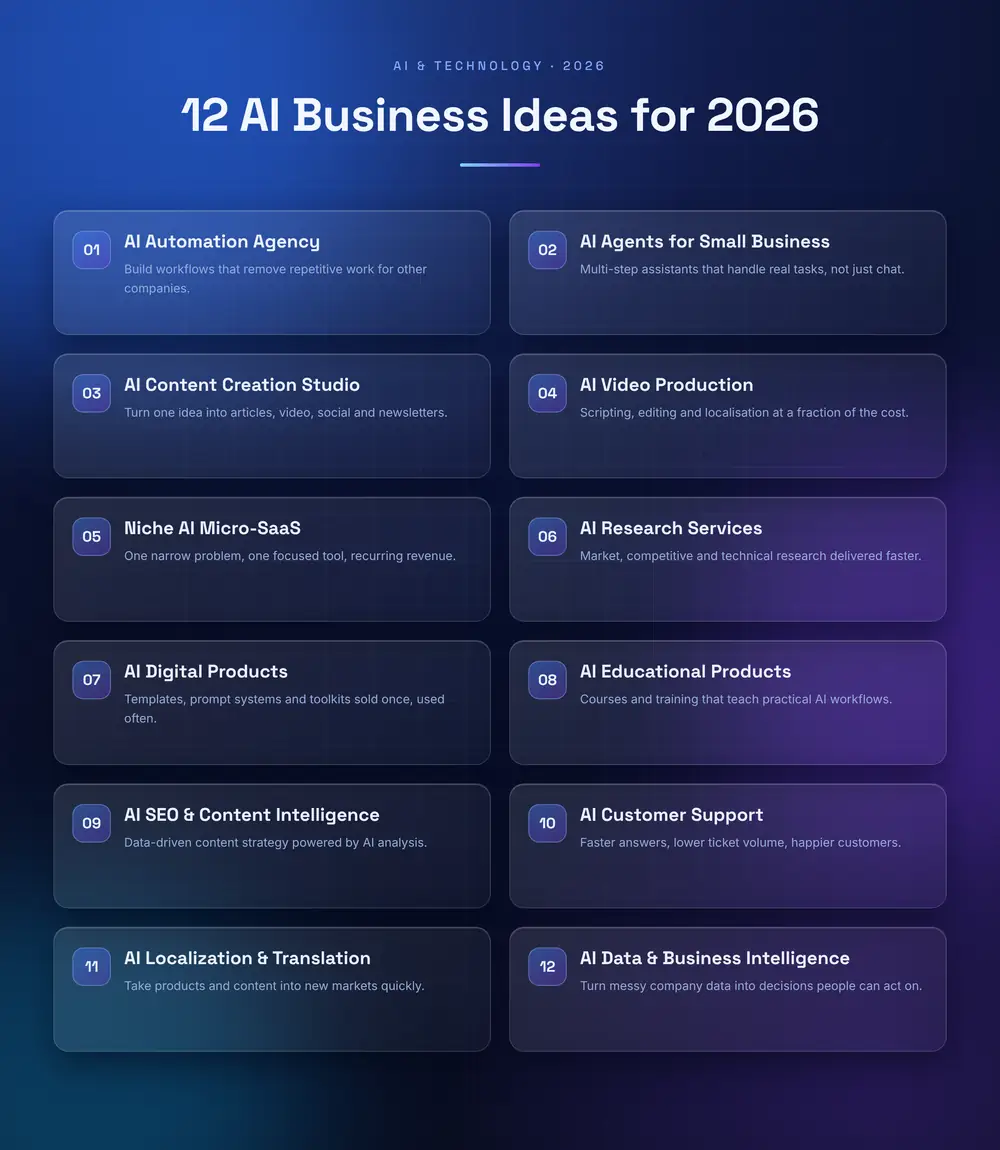
Here are 12 realistic AI business ideas worth exploring in 2026.
1. Start an AI Automation Agency
Difficulty: Medium | Startup Cost: Low to Medium | Business Model: Setup fees + monthly retainers | Best Customers: Small and medium businesses
One of the strongest AI business ideas is not creating another chatbot. It is helping existing companies use artificial intelligence effectively. Thousands of businesses still perform repetitive processes manually. Employees copy information between applications, leads arrive through forms and wait hours before receiving a response, customer questions are repeatedly answered by humans, and reports require employees to collect information from several disconnected systems.
An AI automation agency identifies these inefficient workflows and redesigns them using a combination of artificial intelligence and traditional automation. Imagine a real-estate agency receiving leads through its website. Instead of an employee manually processing every inquiry, a workflow could receive the lead, identify what type of property the prospect wants, organize the information inside a CRM, prepare a personalized response, notify the appropriate salesperson and schedule a follow-up.
In this model, AI handles tasks that require interpretation or drafting, automation moves information between systems, and humans remain responsible for important customer conversations and decisions. That is much more valuable than simply telling a company, “We can install AI.” You are selling an outcome: faster response times, less repetitive work and a more efficient business process.
The strongest way to differentiate an automation agency is through specialization. Instead of positioning yourself as an “AI Automation Agency for Everyone,” focus on something like AI Automation for Real Estate Agencies, AI Automation for Ecommerce Stores, or another clearly defined industry. Specialization makes your offer easier to understand and allows successful workflows to be reused and improved across similar customers.
2. Build AI Agents for Small Businesses
Difficulty: Medium to High | Startup Cost: Medium | Business Model: Development + maintenance subscription | Best Customers: Businesses with repetitive knowledge work
AI agents could become one of the most important business opportunities of the next several years. Traditional generative AI usually waits for a prompt and produces an answer. Agentic systems can go further by participating in workflows, using permitted tools and completing multiple steps toward an objective.
This creates opportunities for specialized business agents. A company might need a sales research agent, customer-support agent, internal knowledge agent, reporting agent, onboarding agent or document-processing agent. Instead of creating one general AI assistant that attempts to do everything, entrepreneurs can build narrowly focused agents designed around a specific business problem.
Imagine a company receiving hundreds of customer emails every day. An AI agent could categorize the messages, retrieve relevant information from approved internal sources, prepare appropriate responses and escalate sensitive cases to employees. The goal is not unlimited autonomy. A well-designed business agent should have clear boundaries defining what it can do automatically and when human approval is required.
This can also create recurring revenue. Instead of charging only for initial development, an AI agent business can provide workflow analysis, implementation, integrations, testing, employee training, maintenance, monitoring and ongoing optimization. As businesses move AI from experimental demos into real operational workflows, these supporting services could become increasingly valuable.
3. Launch an AI Content Creation Studio
Difficulty: Low to Medium | Startup Cost: Low | Business Model: Monthly content packages | Best Customers: Brands, creators and local businesses
Content creation is one of the easiest AI markets to enter, but it is also one of the easiest to enter badly. Generating dozens of generic articles or social posts and selling them to companies is unlikely to create a durable business because almost anyone can now access similar tools.
A stronger model is an AI-assisted content studio where artificial intelligence accelerates production while humans remain responsible for strategy, originality, brand voice and quality control. Such a studio could produce blog articles, newsletters, social-media content, short-form videos, product visuals, advertising creatives and content repurposing.
Imagine interviewing a company’s founder once for 45 minutes. That single conversation could become an authoritative article, a newsletter, several LinkedIn posts, three short videos, social-media visuals and a detailed FAQ page. AI is not replacing creativity in this workflow. It is multiplying one valuable source of original information across several formats.
Again, specialization can create a stronger business. An AI Content Studio for SaaS Companies, AI Content Studio for Restaurants or AI Content Studio for Real Estate is easier to position than another generic marketing agency. You can then develop repeatable research, creation and distribution workflows specifically for that industry.
4. Create an AI Video Production Business
Difficulty: Medium | Startup Cost: Low to Medium | Business Model: Per video or monthly packages
Professional video production has traditionally required cameras, locations, lighting, actors, editors and motion designers. Generative AI is reducing some of these barriers, making sophisticated visual production accessible to much smaller teams.
An AI-assisted video studio could create social advertisements, product explainers, educational videos, short-form content, visual concepts and localized marketing campaigns. However, the key word is assisted. AI-generated footage alone is not a business. Clients pay for effective communication, not for the number of AI models used behind the scenes.
Successful video businesses still need to understand storytelling, hooks, pacing, branding and calls to action. A skincare company, for example, probably does not care whether five different AI tools were used to create its advertisement. It cares whether the finished creative communicates the product effectively and helps generate customers.
Localization could become an especially interesting niche. A studio could take one successful advertising concept and adapt it for several countries using different languages, voiceovers, subtitles, visuals and cultural references. That is a much stronger value proposition than simply selling “AI-generated videos.”
5. Build a Niche AI Micro-SaaS
Difficulty: High | Startup Cost: Medium | Business Model: Monthly or annual subscription | Scalability: Very High
For technical entrepreneurs, a niche AI micro-SaaS can be one of the most attractive opportunities. A micro-SaaS is a focused software product designed to solve one narrow problem, and artificial intelligence dramatically expands the kinds of problems that small software products can address.
The mistake is building “another AI writer” or another generic chatbot. Those markets are already extremely competitive. Instead, look for a narrow workflow where AI creates obvious value. You could build an assistant that converts construction-site notes into standardized reports, software that transforms supplier information into structured ecommerce catalogs, or a system that analyzes thousands of customer reviews and identifies recurring complaints.
The formula is straightforward: specific customer + painful workflow + useful AI capability + simple interface. The more specific the problem, the easier the product becomes to explain and market.

Before building the complete platform, talk to potential customers. A technically impressive product nobody needs is still a failed business. Validate the pain first and build the technology second.
6. Sell AI-Powered Research Services
Difficulty: Medium | Startup Cost: Very Low | Business Model: Projects, subscriptions or reports
AI can analyze and organize large quantities of information much faster than traditional manual workflows, but many companies lack the time or expertise to transform that capability into useful intelligence. This creates an opportunity for specialized research businesses.
Potential customers could include startups researching competitors, ecommerce companies analyzing customer sentiment, agencies studying industries and businesses evaluating new markets. The key is that you are not selling an AI-generated document. You are selling decision-ready research.
Suppose a company wants to enter a new geographic market. Instead of sending the management team 100 disconnected links, your service could prepare a structured report covering competitors, pricing, customer complaints, market positioning, potential opportunities and major risks.
Artificial intelligence can accelerate the collection and organization of information, while humans verify important claims, evaluate source quality and interpret the findings. This human verification becomes particularly important when research will influence high-stakes business decisions.
7. Create AI Digital Products
Difficulty: Low | Startup Cost: Very Low | Business Model: One-time sales or bundles
Digital products remain attractive because they require no physical inventory, delivery can be automated and one product can potentially be sold repeatedly. AI can accelerate the creation process, but the market for generic AI-generated ebooks and prompt collections is becoming increasingly crowded.
Instead of generating thousands of random products, solve a specific problem for a specific audience. Potential products include industry-specific templates, workflow systems, business checklists, research frameworks, educational resources, design assets and specialized prompt systems.
For example, instead of selling “500 ChatGPT Prompts,” you could build an AI Client Acquisition System for Freelance Designers containing lead-research workflows, outreach frameworks, proposal templates, follow-up systems and onboarding checklists.
The second product is stronger because the customer immediately understands who it is for and what outcome it is designed to produce.
8. Build AI-Powered Educational Products
Difficulty: Medium | Startup Cost: Low | Business Model: Courses, memberships or subscriptions
Education is another industry being transformed by artificial intelligence, but there is already an enormous amount of free AI information online. Recording another generic course called “How to Use AI” may therefore be difficult to differentiate.
A stronger opportunity is specialized education. Instead of teaching AI to everyone, teach AI for accountants, AI for real-estate agents, AI for researchers, AI for teachers, AI for content creators or another clearly defined professional audience.
The narrower the audience, the more practical the training can become. A real-estate course should not simply show people how to open an AI chatbot. It could teach agents how to research a neighborhood, prepare a property description, create social-media content, organize lead follow-up and maintain human review throughout the process.
People can learn buttons for free. What they are more likely to pay for is a proven workflow adapted to their profession.
9. Start an AI SEO & Content Intelligence Service
Difficulty: Medium | Startup Cost: Low | Business Model: Monthly retainer
SEO businesses have existed for decades, and AI does not eliminate the fundamentals of search. What it does change is the speed at which certain research, analysis and optimization tasks can be performed.
A modern AI-assisted SEO service could identify content gaps, organize topic clusters, analyze competitors, discover internal-link opportunities, update outdated articles and transform website analytics into actionable recommendations.

The weak positioning would be, “We generate 1,000 SEO articles with AI.” Volume alone is not a strategy, and publishing large amounts of low-value content can create more problems than opportunities.
A stronger positioning is, “We build topical authority around subjects that attract qualified customers for your business.” Artificial intelligence accelerates research and analysis, while human expertise determines what deserves to be published and how the website should develop strategically.
10. AI Customer Support Optimization
Difficulty: Medium | Startup Cost: Low to Medium | Business Model: Setup + recurring management
Many companies receive the same questions repeatedly: Where is my order? What are your opening hours? How do I reset my password? What is your refund policy? Does this product work with a particular device?
AI can help resolve repetitive requests while human employees focus on complicated cases. This creates an opportunity for consultants specializing in customer-support optimization rather than simply selling chatbots.
The service could involve analyzing existing support tickets, organizing the company’s knowledge base, identifying repetitive questions, designing automated workflows, integrating AI assistants, creating escalation rules and analyzing questions that the system fails to resolve.
The value proposition is easy for a company to understand: faster responses, less repetitive work for employees and a more consistent customer experience.
11. Start an AI Localization and Translation Agency
Difficulty: Medium | Startup Cost: Low | Business Model: Projects or recurring localization
The internet is global, but most content is not. Businesses often create excellent marketing materials in one language and struggle to adapt them effectively for other markets.
Artificial intelligence makes translation dramatically faster, but professional localization involves much more than translating words. A US advertising slogan may sound unnatural when translated literally into Arabic. A French campaign may require different cultural references for another market. Pricing examples may need different currencies, while video narration may require different pacing and visual context.
An AI-assisted localization agency can combine technology with human review to adapt websites, ecommerce catalogs, advertisements, videos, newsletters and documentation for different markets.
This model could be particularly valuable for companies expanding internationally because the service is tied directly to a meaningful business outcome: entering new markets more efficiently.
12. Build an AI Data & Business Intelligence Service
Difficulty: Medium to High | Startup Cost: Medium | Business Model: Consulting + dashboards + subscriptions
Businesses collect enormous amounts of information, but data without interpretation has limited value. Many smaller companies have customer and operational data scattered across spreadsheets, CRM systems, ecommerce platforms, advertising dashboards and customer-support software.
They may have all this information yet still struggle to answer basic questions: Which customers are most profitable? Why did sales decline? Which products generate repeat purchases? What complaints appear most frequently? Where are potential customers being lost?
An AI-powered business intelligence service could connect approved data sources, analyze patterns and translate the results into understandable recommendations for decision-makers.

This demonstrates an important point about the future of AI entrepreneurship: AI businesses do not have to be content businesses. Some of the largest opportunities may come from helping organizations understand their own information and make better decisions.
Which AI Business Should You Start?
Do not choose an AI business simply because it sounds futuristic. Choose according to your existing advantages, the problems you understand and the customers you can realistically reach.
Start with what you already know. If you have spent ten years working in real estate, building solutions for real-estate agencies probably gives you an advantage over randomly entering healthcare. Industry knowledge helps you understand customer language, workflows, frustrations and buying behavior.
Then identify a painful problem. Good businesses remove friction. Look for processes that are repetitive, expensive, slow or frustrating. A problem that costs a business several hours every week is usually more interesting than something people merely find “cool.”
Finally, determine whether someone will actually pay to solve it. Interest is not the same as demand. Before spending months developing software, try selling the solution manually. If nobody wants the outcome before you automate it, software is unlikely to magically create demand.
Service Business vs AI SaaS
Beginners often assume that starting an AI business means building software immediately. That is not necessarily true. In many cases, starting with a service can actually be the smarter strategy.
Suppose your long-term goal is creating AI software for real-estate agencies. Instead of spending six months building a platform based on assumptions, you could begin by offering AI automation consulting to five agencies. Working directly with those customers will teach you what they actually need, what they are willing to pay for, which integrations matter and which problems repeatedly appear.
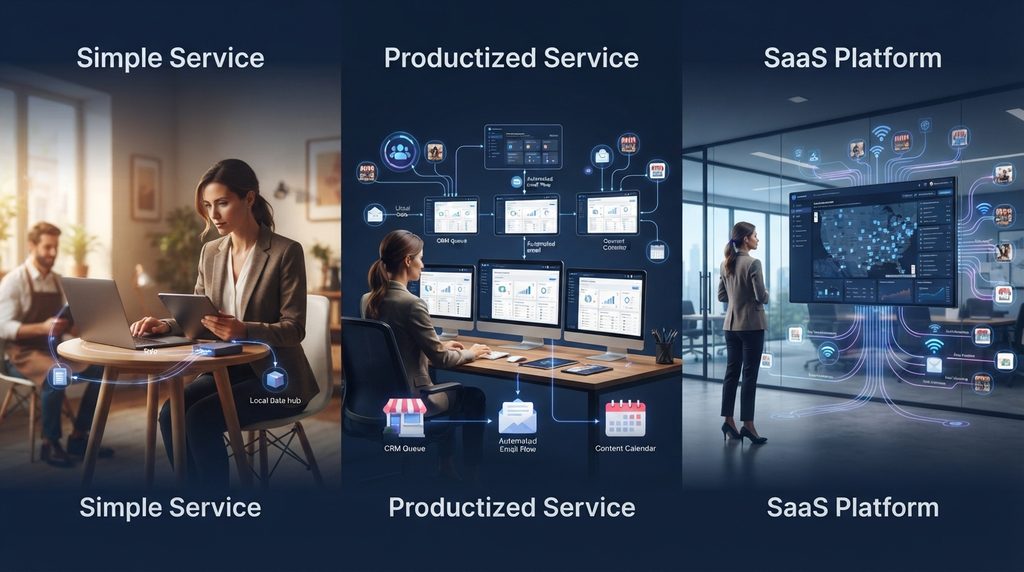
Once the same workflow appears across several clients, you can standardize the service and eventually transform it into software. A useful progression is Service → Productized Service → Software.
This approach reduces risk because the product evolves from real customer behavior rather than assumptions.
How to Validate an AI Business Idea
Validation should happen before major investment. Start by choosing a narrow customer segment and speaking directly with potential buyers. Instead of asking, “Would you use AI?” ask how they currently perform the process you want to improve, how long it takes, what it costs, what happens when it fails and whether they have previously paid for a solution.
You are searching for evidence of pain, not compliments about your idea.
Once you understand the problem, create the simplest possible offer and attempt to find a pilot customer. If someone is willing to pay for the outcome before you have built an elaborate platform, that is a much stronger signal than hundreds of people saying the idea sounds interesting.
How Much Does It Cost to Start an AI Business?
One advantage of many AI businesses is that initial infrastructure costs can be relatively low. A service business may initially require only a domain, a simple website, several carefully selected AI tools, automation software and basic communication infrastructure.
You do not necessarily need an office, employees or subscriptions to 30 different AI platforms. Start lean and add technology only when a real customer requirement justifies it.
For many founders, the largest initial investment will actually be time: learning, testing workflows, speaking with potential customers, improving the offer and developing industry expertise.
The AI Business Stack
A practical AI business can be understood as several layers working together. The intelligence layer contains the AI model or assistant. Automation moves information between systems. The data layer contains spreadsheets, databases or customer systems. The interface allows customers or employees to interact with the service. Payment infrastructure handles billing, while analytics measure usage and business outcomes.
You do not need all of these components on day one. A service can begin almost entirely manually. In fact, automating a process before understanding it can create unnecessary complexity.
Learn the workflow first. Standardize it second. Automate it third.
The Most Important AI Business Trend: Agents
If there is one trend entrepreneurs should watch carefully in 2026, it is agentic AI. AI agents represent a transition from systems that primarily generate isolated outputs toward systems capable of participating in broader workflows.
This could create an entire services economy around agent development, integration, monitoring, governance, optimization and security. Today’s AI automation consultant could eventually become a company responsible for building and maintaining parts of another organization’s AI workforce infrastructure.
The opportunity is particularly interesting because companies will need more than technology. They will need people who understand business processes well enough to determine which tasks should be automated, which tools an agent should access and when a human must remain in control.
How to Build Your First AI Business in 30 Days
Do not spend your first month designing a perfect logo, building an enormous website or developing software nobody has requested. Spend it understanding a problem.
During the first week, choose one industry and speak with potential customers. During the second week, identify one recurring workflow and create the simplest possible solution. During the third week, approach potential customers with a pilot offer. During the fourth week, deliver the service manually, measure the results and improve the process.
Your first version does not need to be infinitely scalable. It needs to be useful.
Once several customers repeatedly request the same solution, begin standardizing the workflow. That is when automation and software become significantly more valuable.
Common AI Business Mistakes
One of the biggest mistakes is starting with technology instead of customers. Another is selling vague promises such as “AI transformation” or “10X your company with artificial intelligence.” Customers need to understand exactly what they are buying.
A much stronger offer is specific: “We automate qualification of incoming leads so your sales team spends more time speaking with qualified prospects.” The customer understands the problem, the solution and the expected operational benefit.
Another common mistake is automating a process you do not understand. If the existing workflow is broken, automation may simply make the broken process operate faster. Understand first. Automate second.
Founders should also avoid building their entire business around one particular AI tool. Platforms change, prices change and new models appear constantly. Build your value around solving the customer’s problem rather than access to one piece of software.
Do You Need to Know How to Code?
Not necessarily. Several of the AI business ideas in this guide can be started without advanced programming knowledge. Content services, research, consulting, education and certain automation businesses can use existing platforms.
Programming becomes more important when developing custom software, advanced integrations or proprietary AI systems. However, artificial intelligence is also reducing the barrier to prototyping software, allowing non-technical founders to test concepts more quickly.
That does not mean AI-generated code should automatically be considered production-ready. Real software still requires attention to security, reliability, privacy, testing and maintenance.

AI Business Ethics, Privacy and Trust
Trust could become one of the most valuable competitive advantages in the AI economy. If your business handles customer information, clients should understand what data is being collected, why it is needed, which systems process it and how it is protected.
AI businesses should also avoid making decisions automatically simply because the technology makes automation possible. Sensitive financial, employment, legal or personal decisions may require strong human oversight.
Transparency matters as well. Customers should not be misled into believing they are interacting with a human when that distinction is important to the service.
Businesses that combine useful AI capabilities with responsible data practices and clear human accountability may ultimately build stronger customer relationships than competitors focused only on maximum automation.
Frequently Asked Questions
What is the best AI business to start in 2026?
There is no single best AI business for everyone. The strongest opportunity usually combines an industry you understand, a painful customer problem and an AI capability that can solve that problem more efficiently. For beginners, service businesses such as AI automation, research, content production or specialized consulting can be easier to validate than building software immediately.
Can I start an AI business without coding?
Yes. Many AI businesses can be started using existing AI and automation platforms. Coding becomes more important when you want to create proprietary software or complex integrations.
How much money do I need to start an AI business?
Some service-based AI businesses can begin with relatively little capital because they require mainly software subscriptions, a website and your time. SaaS products and custom agent systems usually require greater technical and financial investment.
Is AI content creation still profitable?
It can be, but generic AI-generated content is becoming increasingly commoditized. Businesses are more likely to pay for strategy, original expertise, strong creative direction, distribution and measurable outcomes than for raw AI output.
Are AI agents a good business opportunity?
Potentially, yes. Businesses increasingly want AI systems that can participate in real workflows rather than simply answer questions. Opportunities may emerge around building, integrating, monitoring, securing and maintaining specialized business agents.
Should I build an AI SaaS or start with a service?
For many beginners, starting with a service is safer. It allows you to understand real customer problems before investing heavily in software. Repeated customer workflows can later become productized services or SaaS products.
Conclusion: Don’t Sell AI — Sell the Outcome
The biggest opportunity in artificial intelligence is not convincing people that AI is impressive. They already know that.
The opportunity is identifying expensive, repetitive or frustrating problems and using AI to solve them better.
A real-estate agency does not need “artificial intelligence.” It needs faster lead response. An ecommerce company does not need another chatbot. It needs fewer repetitive support tickets. A marketing department does not need 100 AI tools. It needs better content produced efficiently. A business owner does not need an AI dashboard simply because it looks futuristic. They need clearer information for better decisions.
That is the principle connecting the strongest AI business ideas in 2026: sell the outcome, not the technology.
Start with one customer. Find one painful problem. Build the simplest useful solution. Get someone to pay for it. Improve the process. Then automate what repeatedly works.
Artificial intelligence can provide leverage, but it does not replace the fundamentals of entrepreneurship. Customers, problems, trust, execution and measurable value still matter.
The entrepreneurs who understand that distinction may have the strongest opportunity of all.